Introduction
An AI agent can produce a 466-line configuration artifact, every section header present, every value plausible, and declare the work complete. That artifact can be wrong in ways that no visual inspection will catch. Not randomly wrong. Confidently, structurally, invisibly wrong.
This article is about two failure modes I encountered while building my own personal architecture tooling, and the AI governance implications that follow from them. The first is what I now call the Pattern-Matching Trap. The second is Context Displacement of Process Instructions. Together they explain why agentic AI systems produce outputs that look finished but are not, and what you can do about it without fighting the underlying mechanism.
This expands on my video about these two concepts, where I walk through the specific incident that forced me to name them: Watch on YouTube. The video covers the story in detail. This article goes deeper on the structural explanation and gives you a framework you can apply to your own AI agent workflow immediately.
If you are using AI agents to generate configuration files, documentation artifacts, or any structured output against governing standards, these failure modes are relevant to your work. You may not have seen them yet. In my experience, that usually means you have not asked the right diagnostic question, not that the problem is absent.

Why AI governance fails at the artifact level
The standard framing of AI risk in enterprise contexts focuses on data privacy, model bias, and output hallucination. These are real concerns. But there is a quieter failure mode operating at the artifact level that gets far less attention: an agent producing outputs that are structurally plausible but specification-non-compliant, with no signal in the output itself that anything is wrong.
This matters because the workflows where it occurs look like productivity. An agent generates a complete artifact in minutes. A human reviews it, sees a well-formed structure, and accepts it. The compliance gap is invisible because the artifact passes every visual test. The governing standard was never consulted. Neither the agent nor the human noticed, because neither was prompted to check.
In my experience building and iterating on my own architecture tooling, this failure mode is not occasional. It is the default behaviour of an agentic system operating without explicit governance checkpoints. The agent does what large language models do: it finds the most structurally similar existing artifact and replicates its form. If the source artifact was itself non-compliant, the new artifact inherits that non-compliance. If the governing standard has evolved since the source artifact was created, the new artifact reflects the old standard, not the current one.
The architectural implication is significant. When you introduce AI agents into any workflow that produces governed artifacts, you are not just adding a productivity tool. You are adding a system that will systematically replicate whatever structural patterns already exist in your repository, regardless of whether those patterns conform to current standards. Without explicit governance mechanisms, the agent amplifies existing compliance gaps rather than closing them.
This is not a criticism of large language models. It is a description of how they work. Pattern completion is the mechanism. The question for anyone building AI agent workflows is whether the governance structure around the agent accounts for that mechanism or ignores it.
Understanding the mechanism precisely is what makes it governable. Treating it as a black box that occasionally makes mistakes leads to ad hoc fixes. Treating it as a predictable system with a known failure mode leads to structural solutions.
Two failure modes, one underlying mechanism
The pattern-matching trap
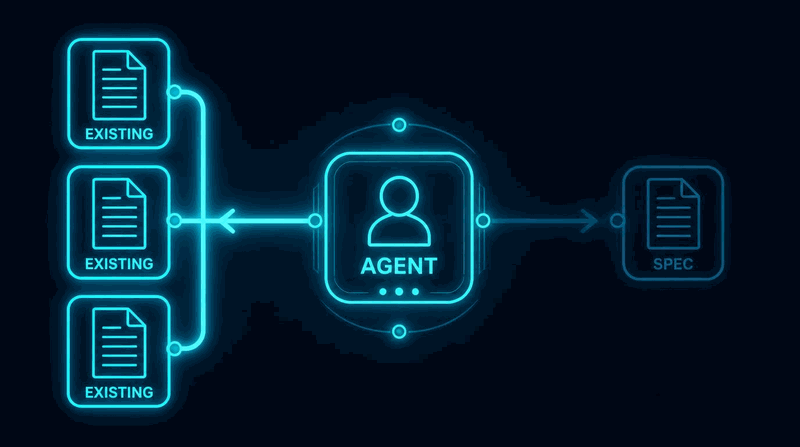
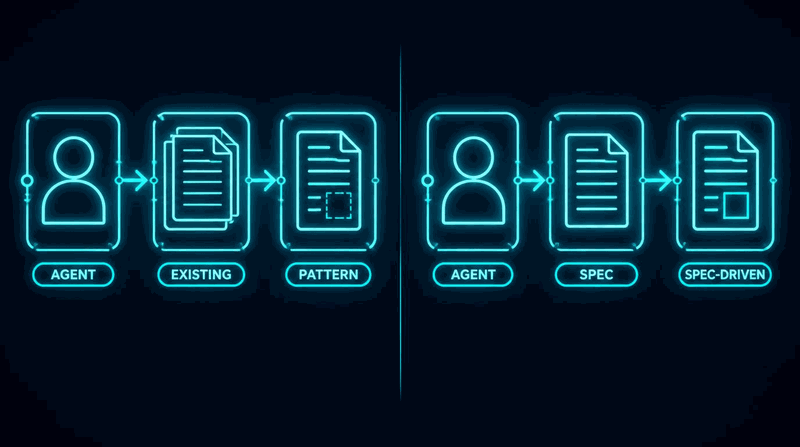
Large language models are not procedure followers. They are pattern completers. When you assign an agentic AI a task, it does not begin by asking what the rules are. It begins by asking what this looks like. It answers that question by locating the nearest structural match in everything it can access, and it uses that match as the template for its output.
In the incident that prompted this article, I assigned an agent the task of creating a new configuration artifact for a design system I maintain. Governing standards existed in the repository. Capability architecture documents existed. Implementation guides existed. All of it was accessible to the agent. The agent did not search for the governing standard. It searched for existing files of the same type, found one, and replicated its structure into a new 466-line artifact. Every section header matched the source. Every value looked correct. The agent declared the file complete.
I accepted it. I was looking at a mirror image of an existing file and calling it specification-compliant. Neither I nor the agent had checked the specification.
A single question broke the situation open. I asked: "Does the architecture documentation say anything about presentation configuration?" The agent searched documentation it had not opened during the original task, and found an entire required section. Missing. From the file it had just declared finished.
This is the Pattern-Matching Trap in precise terms: the systematic tendency of an LLM to locate existing artifacts that resemble the requested output and replicate their structure, producing results that appear complete but silently omit requirements that the source artifacts themselves were missing. The trap does not produce obviously wrong outputs. It produces plausible outputs that pass casual inspection. The gap is invisible until someone asks a question the agent had no reason to ask itself.
The confidence level of a pattern-matched output is identical to the confidence level of a specification-driven output. There is no signal in the delivery that tells you which one you are looking at. That is what makes this a genuine AI governance concern rather than a simple quality assurance problem.
Context displacement of process instructions
After identifying the pattern-matching trap, I did what seemed like the logical fix. At the start of the next session, I gave the agent an explicit instruction: documentation is the primary source, consult it before implementation. The agent acknowledged the instruction clearly.
Minutes later, I assigned an implementation task. The agent searched for existing files to copy.
This is not defiance and it is not forgetting. It is how LLM context windows operate. Recent tokens carry more weight than earlier ones. A concrete task, "create this file," activates pattern-matching more strongly than an abstract process instruction given earlier in the session, "consult documentation first." The process instruction had been displaced. Not erased. Displaced. The task context moved to the front of the context window, and the earlier instruction drifted toward the back where it exerted less influence on the output.
The critical distinction here is between confirmation and retention. When an agent confirms an instruction at the start of a session, that confirmation is real. The instruction was processed. But retention across a long session depends on what comes after the confirmation. A series of concrete tasks generates substantial context that competes with the earlier instruction. By the time the relevant decision point arrives, the process instruction may no longer be exerting meaningful influence on the agent's behaviour.
This has a direct implication for how you structure AI agent workflows. Instructions given once at session start are not a reliable governance mechanism for long sessions. They work at the moment of acknowledgment and degrade as task context accumulates. The longer and more complex the session, the faster the degradation.
Why these are the same problem
The Pattern-Matching Trap and Context Displacement are both expressions of the same underlying mechanism: LLMs operate on what is most immediate and most structurally familiar. They complete patterns based on the strongest available signal at the moment of generation. They do not hold process intent across a session. They do not compare output against specification without being prompted.
This is not a flaw to be corrected in a future model version. It is the mechanism. Governing it means working with the mechanism, not against it. That distinction changes everything about how you design your AI governance framework.
Before I understood this, I measured success by whether the agent produced a complete-looking output. After I understood this, I measured success by whether the agent could cite the governing standard by name and identify the specific requirement it had satisfied. The length of the file is irrelevant if the specification was never read.
The diagnostic question
The most reliable detection method I have found is a checkpoint question that forces specification lookup. Before accepting any LLM-generated artifact, ask: "Did you read the governing standard, or did you copy from an existing file?"
If the agent cannot name the standard and cite specific requirements from it, the output is pattern-matched, not specification-driven. In my experience, this question has surfaced a compliance gap every single time I have applied it after the agent declared completion. Your situation may differ depending on how well your existing artifacts already conform to current standards. But the diagnostic question applies regardless, because the agent cannot tell you the difference between those two cases without being prompted to check.
The question works because it creates immediate context pressure toward specification lookup. It does not rely on the agent remembering a process instruction from earlier in the session. It makes the correct next step concrete and immediate, which is precisely the condition under which LLMs perform specification-driven work rather than pattern-matched work.
Building an AI governance framework around these failure modes
Understanding the two failure modes points directly toward three structural measures. These are not workarounds. They restructure the AI agent workflow itself so that the correct behaviour becomes the path of least resistance at every decision point.
Make the specification path easier than the pattern-matching path
The agent will match the nearest available pattern. Your job is to ensure the nearest available pattern is a correct one. After the incident described above, I created a template file containing all required sections as defined by the governing standard. This template is now the most structurally similar file the agent will find when searching for artifacts of this type. It will match that one.
This approach also surfaces a valuable side effect. Building the template requires you to read the governing standard carefully and encode its requirements explicitly. That process often reveals gaps in the standard itself, which you can address before the agent ever encounters them. In the session following my incident, we committed three documentation improvements: a governing standard update, a new template file with all required sections, and an enhanced entry-point document with a mandatory reading list for agents beginning this type of task.
Use checkpoint questions at decision boundaries, not instructions at session start
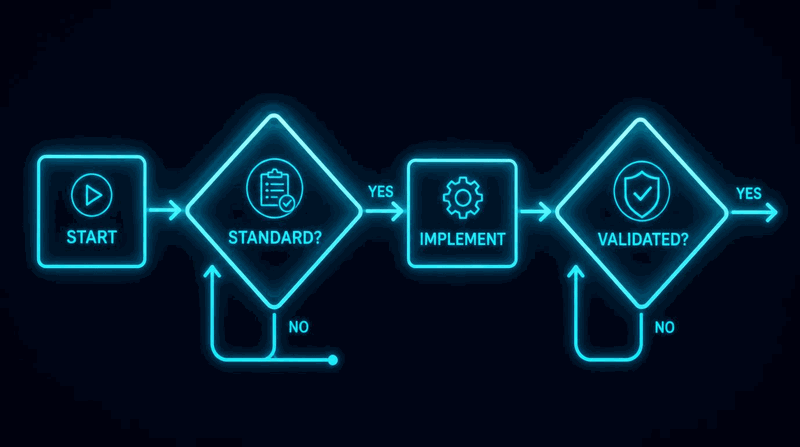
Replace the instruction-at-session-start approach with a phase-gated interaction model. Before implementation, ask: "What standard governs this artifact?" After implementation, ask: "Present your validation checklist with your assessment against each required section." Each checkpoint forces the agent into research mode at the moment it matters, not twenty minutes earlier when the instruction will be displaced by subsequent task context.
This approach works because checkpoint questions create immediate, concrete next steps. The agent does not need to remember a process. The question makes the required action the only available action at that point in the conversation. In my experience, agents consistently consult documentation when a checkpoint question makes that the immediate next step, even in sessions where an earlier process instruction has been effectively displaced.
Treat agent confirmation as acknowledgment, not retention
This is a mindset shift as much as a process change. When an agent confirms a process instruction, that confirmation is accurate at the moment it occurs. Do not interpret it as a commitment that will persist across the session. Design your governance checkpoints on the assumption that any instruction given more than a few exchanges ago is operating at reduced influence. The checkpoint question at the decision boundary is your primary governance mechanism, not the instruction at session start.
A common pitfall is accepting a well-formed output structure as evidence of specification compliance. Length, formatting, and section completeness are properties of pattern-matched outputs as much as specification-driven ones. The only reliable evidence of compliance is the agent's ability to name the governing standard and cite the specific requirement each section satisfies. Build that verification into your acceptance criteria, not as an optional review step but as a required checkpoint before the artifact is committed.
Closing the compliance gap before it compounds
The hardest part of AI governance at the artifact level is not the tooling. It is the human tendency to accept confident outputs as correct outputs. An agent's confidence is not evidence of compliance. It is evidence that a pattern was found. Those are not the same thing, and conflating them is how silent non-compliance accumulates across a repository over time.
The three measures described here do not require changes to the underlying model or access to new tooling. They require changes to how you structure the interaction: a template that encodes the correct pattern, checkpoint questions at decision boundaries, and a clear-eyed understanding of what agent confirmation does and does not guarantee. In my experience, applying these measures consistently has prevented every pattern-matching compliance gap I have encountered since naming this problem. Your mileage may vary depending on your tooling, your repository structure, and how mature your governing documentation already is.
The diagnostic question is the fastest way to assess your current exposure. Before accepting the next AI-generated artifact in your work, ask: "Did you read the governing standard, or did you copy from an existing file?" If the agent cannot name the standard and cite a specific requirement, you have your answer. You will know what you are looking at in the time it takes to ask.
If this failure mode is present in your current workflow, share this article with the person responsible for your AI agent governance. The pattern-matching trap and context displacement are not edge cases. They are the default behaviour of agentic systems operating without explicit governance structure. Naming them is the first step toward governing them.