Introduction
Most architects spend their first week in a new engagement solving the wrong problem. They focus on demonstrating competence when the actual challenge is establishing the conditions under which their competence can be received. This article examines what I call the Joining Problem: the structural mismatch between how architects are trained to present themselves and what actually builds the relationships that make architectural work land.
This expands on my video about the Joining Frame, where I walk through a specific engagement that changed how I approach every new role. The video covers the personal experience in detail. This article develops the underlying pattern and gives you a framework you can apply before your next engagement begins.
The audience for this is architects at any level and developers who carry architectural responsibility without the title. If you have ever walked into a new team with a clear mandate and found that your proposals generated polite resistance rather than traction, the Joining Problem is probably already running. Your mileage may vary depending on your specific context, but the diagnostic question at the centre of this framework applies regardless of seniority or organisation type.
Why arrival framing matters more than architecture skill
There is a persistent assumption in enterprise architecture that the quality of the work is the primary variable determining whether it gets adopted. Architects invest heavily in framework fluency, deliverable quality, and stakeholder analysis, and those investments are not wasted. But they are downstream of a prior variable that most architects never examine because it feels too obvious to question: the frame they use to announce their own arrival.
Arrival framing is not about first impressions in the soft-skills sense. It is a structural signal that tells the existing team how to categorise you before you have produced a single deliverable. That categorisation is sticky. Once it forms, it shapes how every subsequent proposal is interpreted. A proposal from someone the team has categorised as "here to tell us what to do" lands differently from the same proposal delivered by someone categorised as "here to work with us." The content can be identical. The reception will not be.
The reason this matters specifically for architects is that architecture work is inherently cross-cutting. Unlike a developer who can deliver value within a bounded scope, an architect's effectiveness depends on relationships across teams, functions, and sometimes organisations. Those relationships are formed in the first thirty days, largely before any meaningful technical work has been completed. If the arrival frame signals that the architect has arrived with a closed agenda, the relationships that form will reflect that signal. They will be polite, transactional, and thin. Thin relationships do not carry the weight of architectural proposals that require people to change how they work.
In my experience, this dynamic is more acute in cross-cutting roles than in embedded team roles. When you are hired as an architect who spans multiple teams, you have no delivery record within those teams. You are asking people to extend trust based on your title and your mandate, both of which are external impositions from their perspective. The arrival frame is the only instrument you have to shape how that trust is extended before your work can speak for itself.
There is also a compounding effect that makes early framing decisions disproportionately consequential. The team's interpretation of who you are solidifies over the first month. After that point, changing their interpretation requires them to revise something they have already settled, which is a cognitive cost they will resist unless they have a strong reason to bear it. Getting the frame right at arrival is not just easier than correcting it later. In practice, correcting a wrong arrival frame is so costly that many architects simply carry the consequences of the original mistake through the entire engagement.

The Joining Frame: a framework for deliberate arrival
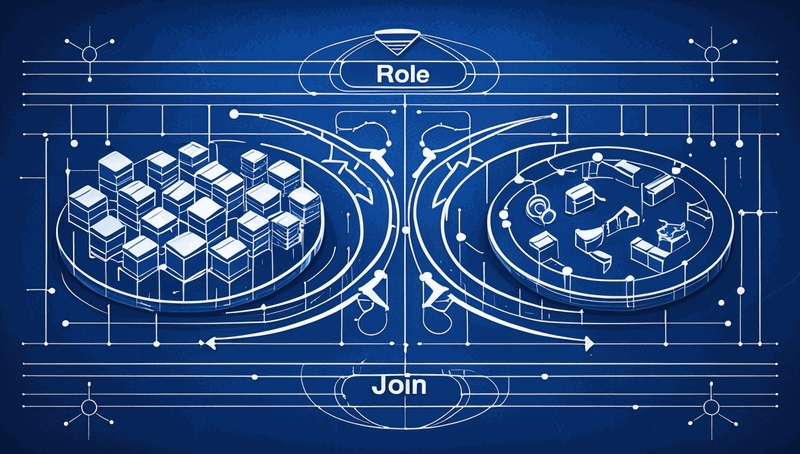
The Joining Frame is a deliberate choice about how to structure the first thirty days of a new engagement. It rests on a single distinction: arriving as someone joining a team versus arriving as someone hired to perform a defined role. Those two postures sound compatible. In practice, they produce measurably different behaviours in the first weeks, and those behaviours produce different relationship outcomes that compound forward through the engagement.
Role-performance mode versus joining mode
In role-performance mode, first conversations are structured around your mandate. You explain what you have been hired to deliver, reference the frameworks you intend to apply, and position your future outputs. The signal this sends, regardless of intent, is that the team's existing work is context for your work. You have arrived with an agenda, and the team's role is to help you execute it.
In joining mode, first conversations are structured around the team's existing work. You ask what is already running. You ask what has been frustrating. You ask what a new person in this seat could do that would actually be useful. The signal this sends is that you are entering a conversation that was already in progress, not opening a new one with your agenda at the centre.
The content you eventually deliver can be identical in both cases. The frame determines whether that content lands.
What the Joining Frame surfaces
In my experience, the Joining Frame does two things that role-performance mode cannot do. First, it surfaces information you would not otherwise reach for weeks. The pain points that never made it into any documentation, the history of failed attempts that explain why certain proposals will be resisted, the informal dynamics that determine who actually has influence regardless of their title. This information sits in the heads of the people who have been there longest, and they will share it with someone who is genuinely curious about their experience. They will not share it with someone who arrived with a blueprint.
Second, the Joining Frame changes how your later proposals are received. When you eventually do propose something, the team has already experienced you as someone who listened before they spoke. That experience is load-bearing. It is what makes the proposal feel like it comes from inside the tent rather than from someone who parachuted in with a predetermined answer. The difference is not rhetorical. Proposals that feel like they come from inside the tent get challenged and refined. Proposals that feel like external impositions get politely parked.
The single slide as a joining move
One of the clearest expressions of the Joining Frame in practice is the kickoff presentation. Most architects approach the kickoff deck as an opportunity to establish clarity: here is what I have been hired to deliver, here are the frameworks I will apply, here is the roadmap I intend to follow. That approach feels professional. It has the structure of competence. And it announces the arrival frame before the team has had any chance to shape it.
In one engagement, I brought one slide to a kickoff that had been scheduled specifically to explain what the new architect would be doing. The slide had three open-ended questions: what is working well that I should be careful not to disrupt, where does the architecture function currently fall short, and what would make the biggest difference in the next three months. I spent the meeting listening.
Three team members stayed afterward to add things they had not wanted to say in the room. One of them turned out to be the most informed stakeholder I had not yet identified, someone I would not have reached for weeks through normal channels if I had walked in with a roadmap and spent the kickoff presenting it.
The observable difference between a single-question slide and a full kickoff deck is not the quality of the content. It is what the format communicates about whose agenda the meeting is serving. A deck full of your planned deliverables signals that the meeting is for you. A slide full of open questions signals that the meeting is for them. That signal is received immediately, and it shapes every conversation that follows.
The first power map
There is a specific application of the Joining Frame that I have found consistently valuable: treating the first people who introduce themselves as the first power map. In most organisations, the people who show up early to meet a new architect are not doing so randomly. They are the ones who have the most at stake in how the new role is interpreted. They may be potential allies, potential competitors for influence, or simply the most engaged members of the team. In every case, they are the people whose interpretation of your arrival will spread most quickly to everyone else.
In my experience, the instinct in those first conversations is to position the role. The introduction window is right there, and the temptation is to use it to establish what you are there to do. What actually serves you better is to ask what they are working on, what has been frustrating about the architecture function before you arrived, and what they hope someone in your seat would do differently. Those questions cost ten minutes of the impulse to establish yourself and buy weeks of permission to operate.
The people who arrive at your desk on day one are not just colleagues. They are going to define how your arrival is interpreted by everyone else in the unit. Joining their conversation before you position your role is not a soft-skills manoeuvre. It is a structural decision about which relationships form first and how strong they are when you need them.
Arrival framing as the primary variable
Most first-90-days advice treats the organisation as the thing to diagnose. Understand the culture, map the stakeholders, read the room before you act. That advice is sound and I apply it. But it positions the architect as the observer and the organisation as the subject. The inversion that changed how I work is treating my own arrival framing as the variable to examine first.
Before diagnosing the organisation, the more productive question is: what signal am I sending about why I am here? The kickoff deck or the single slide, the positioning speech or the open question, these are not stylistic choices. They are arrival framing decisions, and they determine which relationships form, which resistances activate, and whether the architecture you later propose has a chance of landing.
This applies whether the role is formally titled enterprise architecture, solution architecture, or technical leadership, and whether you are working out what an enterprise architect does in a specific context or establishing an architecture function in an organisation that has never had one. The underlying diagnostic question is the same: are your first conversations structured around your agenda or theirs?

Applying the Joining Frame in practice
The practical application of the Joining Frame is straightforward to describe and genuinely difficult to execute. The difficulty is not conceptual. It is that the impulse to position your role is a trained reflex built over years of professional practice, and it activates most strongly in exactly the moments when you most need to suppress it.
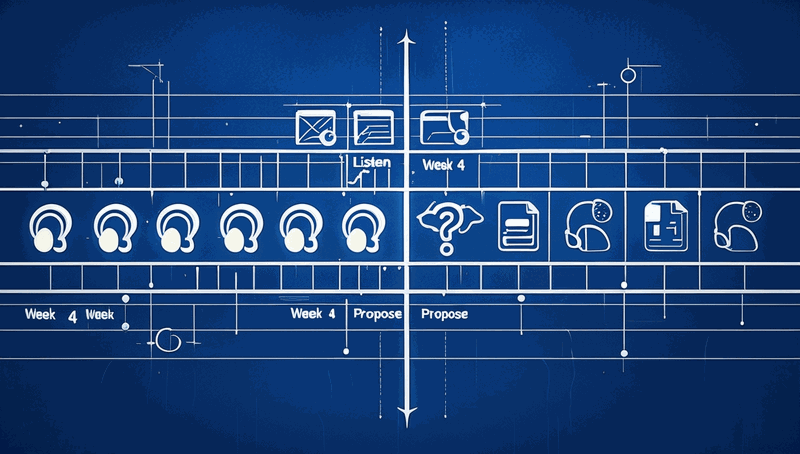
In the first week of a new engagement, the concrete application is to suppress every impulse to position your role, your frameworks, or your future deliverables. Every conversation starts with the team's existing work, not your planned work. Every meeting, you ask more questions than you answer. When you are asked to present, you ask what format would be most useful before you build anything.
The common failure mode is treating the Joining Frame as a listening exercise that ends after the first week. The frame is not a tactic for the first few days. It is a posture that shapes how you structure conversations throughout the first month, because the team's interpretation of who you are is still forming during that period. After approximately thirty days, the interpretation has settled and changing it costs significantly more than getting it right at arrival.
A second common failure mode is confusing the Joining Frame with passivity. Joining mode is not the same as having no agenda. You have been hired for a reason, and you will eventually need to deliver against that reason. The Joining Frame is about sequencing: understanding what the team actually needs before you announce what you intend to provide. The architecture you eventually propose will be stronger for having been shaped by what you learned in joining mode, and it will land better because the team has already experienced you as someone who listened before they spoke.
The specific moves that constitute a joining frame will look different depending on the organisation, the seniority of the role, and the existing team dynamics. In a team under acute delivery pressure, a long listening session on day one may not be the right expression of the joining frame. But the underlying principle applies regardless of context: your arrival signal is the primary variable, and it is worth examining before you examine anything else about the organisation you have joined.
Success in the joining frame looks like this: by the end of the first week, you know things about the team's actual pain points that do not appear in any documentation. By the end of the first month, at least two people in the team have extended informal trust that was not structurally required by your role. And when you eventually propose something, the response is engagement rather than polite resistance.
The reflex does not disappear
Twenty years in, the positioning reflex is still present in the first hours of a new engagement. The impulse to establish what I am there to do, to fill the silence with credentials, to manage the anxiety of being new by talking about the work I intend to produce. I notice it now, which is progress. But I would be overstating things if I said the impulse was gone.
The architects and developers who navigate new engagements well are not the ones who arrive with the most complete picture of what they intend to deliver. They are the ones who arrive with the most genuine curiosity about what is already there. That is a harder skill than it sounds, because professional identity is built on knowing things, and arriving as someone who does not yet know is uncomfortable in a way that no amount of experience fully removes.
Before your next new engagement, or your next kickoff, or the next time a colleague you have not met arrives at your desk to introduce themselves, write down the three questions you would ask if you were genuinely trying to understand their world before you described your own. Then lead with those questions. You will know the frame is working when the conversation runs longer than the introduction window should allow.
If you are thinking about enterprise architect roles and responsibilities more broadly, about what the function is actually for and how to make it land in organisations that are not yet sure they want it, that question is exactly what this channel works through. Watch the video for the personal story behind this analysis: Watch on YouTube. And if you have experienced the arrival trap from either side of the desk, share what you noticed in the comments. We are all still working out how to walk into the room.