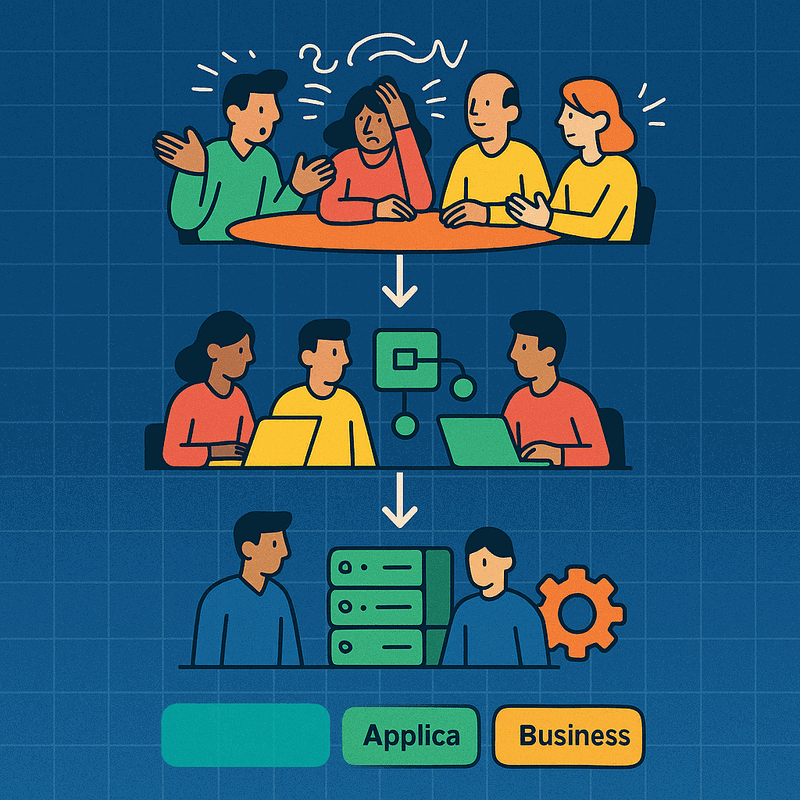
It was my fourth stakeholder meeting at a large government agency, and I was watching another hour disappear into communication chaos. The platform team was explaining technical architecture in precise technical terminology. The development teams were discussing dependencies using their own vocabulary. Ministry stakeholders were asking about business value in language that had nothing to do with either technical perspective.
Everyone was speaking different versions of "urgent business requirement." Zero progress was being made.
What made this worse was the realization that came six months later: I had been making it worse, not better. My attempts to bridge the communication gaps were actually creating more confusion. This is the story of how ArchiMate visualization transformed that chaos into systematic team coordination, and the framework I now use to ensure stakeholder meetings actually produce results.
If you are a solution architect, technical lead, or IT professional struggling with stakeholder communication across multiple teams, this framework will give you a practical approach to visualizing architecture decisions in ways different audiences can understand. The Three-Layer Translation Rule I developed from this experience has since been applied across multiple government and enterprise environments with consistent results.
The Babel Tower Meeting Pattern
Before we get into the solution, let me describe the problem pattern in detail. You have likely experienced some version of this yourself.
Picture a meeting room with representatives from four different teams. The platform team brings deep expertise in infrastructure services, container orchestration, and deployment pipelines. They speak in terms of Kubernetes clusters, CI/CD workflows, and infrastructure as code. The development teams come with application-level concerns: API contracts, service dependencies, data flows, and integration patterns. They speak in terms of microservices, event-driven architecture, and domain boundaries.
Then there are the business stakeholders. In government environments, these are often ministry representatives who care about citizen services, regulatory compliance, and operational outcomes. They speak in terms of business processes, service delivery, and organizational accountability.
Each group is technically correct in their perspective. Each group is articulating genuine concerns. And yet, after an hour of discussion, nothing has been decided because no one can translate between these different frames of reference.
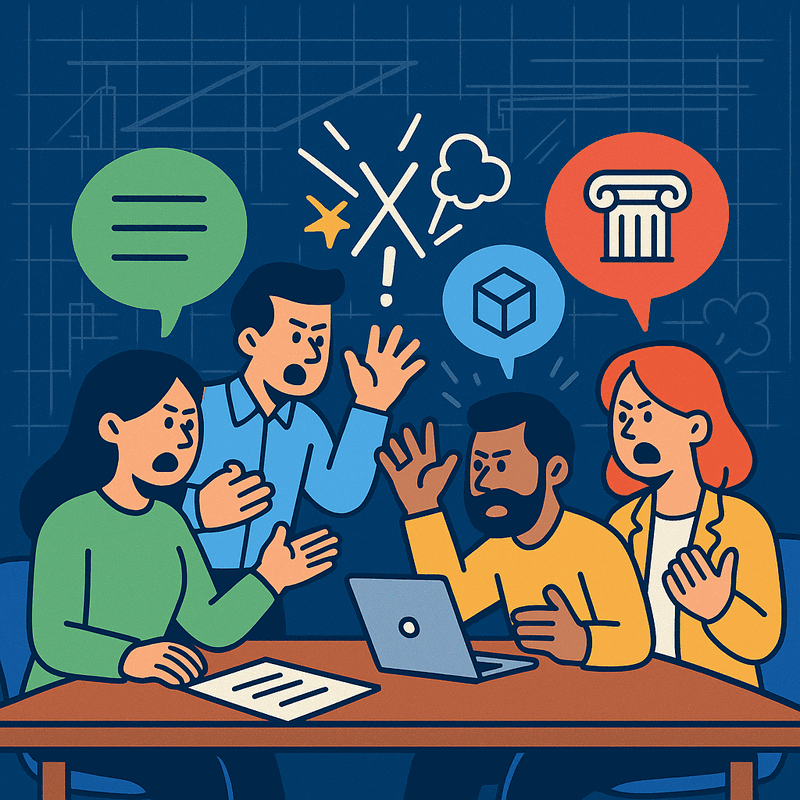
I call this the Babel Tower Meeting Pattern. Like the biblical story, everyone is working on the same project but speaking languages that cannot connect. The result is not conflict, but something worse: parallel conversations that never intersect.
The symptoms are consistent across organizations. Requirements meetings where business stakeholders describe what they want, but development teams cannot determine which applications need to change. Platform coordination sessions where dependency discussions go in circles because no one can agree on what depends on what. Ownership arguments at 3 AM because teams have different mental models of where responsibilities begin and end.
Where I Went Wrong Initially
My first instinct was to become the translator myself. I would listen to each perspective, synthesize it in my head, and try to explain one group's concerns in another group's language. This is exhausting and, as I discovered, ineffective.
The problem with human translation is that it creates a bottleneck. Every communication must flow through the architect, who becomes a single point of failure. More problematically, my translations were inevitably colored by my own understanding and biases. I was not providing neutral translation but interpretation, and different stakeholders would leave meetings with different understandings of what had been agreed.
For six months, I was making coordination worse while believing I was helping. The number of clarification meetings increased. The time to reach decisions stretched longer. Teams became more defensive about their domains because my translations sometimes inadvertently misrepresented their positions.
The breakthrough came when I stopped trying to translate verbally and started visualizing instead. TOGAF gave me the process framework. ArchiMate gave me the visual language. Together, they transformed architecture documentation into architecture conversations that teams could actually understand without my constant interpretation.
The Three-Layer Translation Rule
The framework I developed is called the Three-Layer Translation Rule. The core insight is simple: when everyone speaks different languages, you need a visual translator that all parties can read simultaneously.
ArchiMate provides exactly this through its layered modeling approach. Rather than explaining the connection between business needs and technical implementation verbally, you show it visually in a way that each stakeholder group can interpret according to their own expertise.
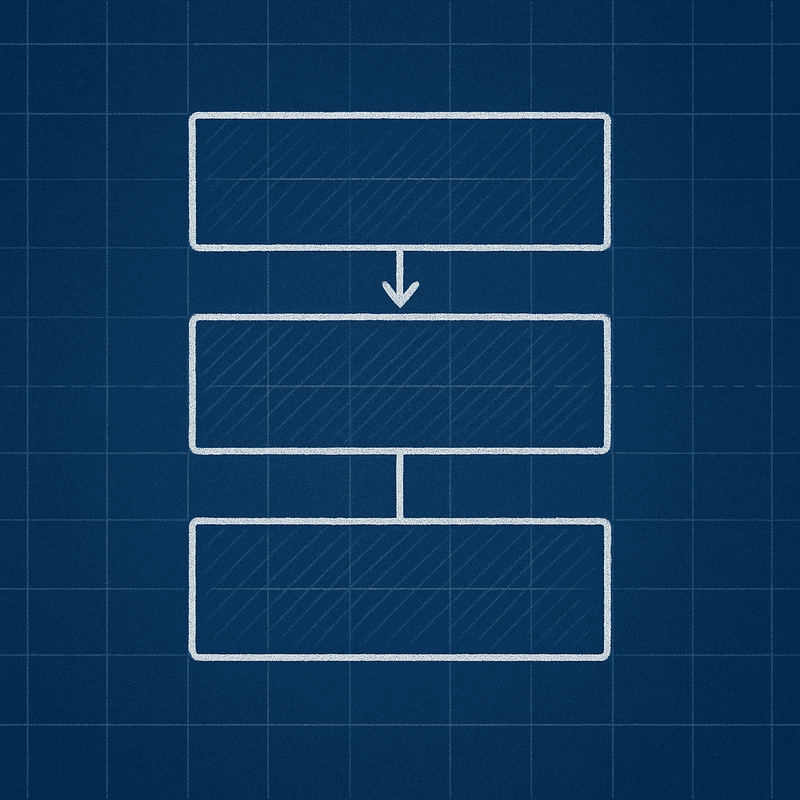
The three layers correspond to the three audience types in most enterprise architecture discussions. The Business Layer shows who does what and why. Business stakeholders can focus here to understand team responsibilities, process flows, and organizational boundaries. The Application Layer shows which systems support the work. Development teams can focus here to understand component ownership, integration patterns, and service dependencies. The Technology Layer shows what infrastructure makes it possible. Platform teams can focus here to understand capacity requirements, deployment targets, and infrastructure services.
The power of this approach is that all three layers are visible simultaneously. A business stakeholder can see their process at the top layer while understanding that applications support it and technology enables it. A developer can see their application in the middle layer while understanding the business context it serves and the infrastructure it requires. A platform engineer can see their services at the bottom layer while understanding the applications they support and the business outcomes they ultimately enable.
When I drew this three-box structure on a whiteboard for the first time, something remarkable happened. The arguments stopped. Not because people agreed, but because they could finally see what they were disagreeing about. The visual model made implicit assumptions explicit. Territorial disputes became visible boundary questions. Dependency debates became traceable flows.
Applying the Framework: A Government Case Study
Let me walk through how this worked in practice at the government agency where I first developed this approach. We had four teams responsible for different aspects of a national-scale citizen services platform. Each team had clear internal expertise but struggled to coordinate across boundaries.
Mapping Team Domains
The first step was mapping each team's domain across all three layers. This is not about creating comprehensive ArchiMate models. It is about creating enough visual structure that teams can see where they fit and where they connect.
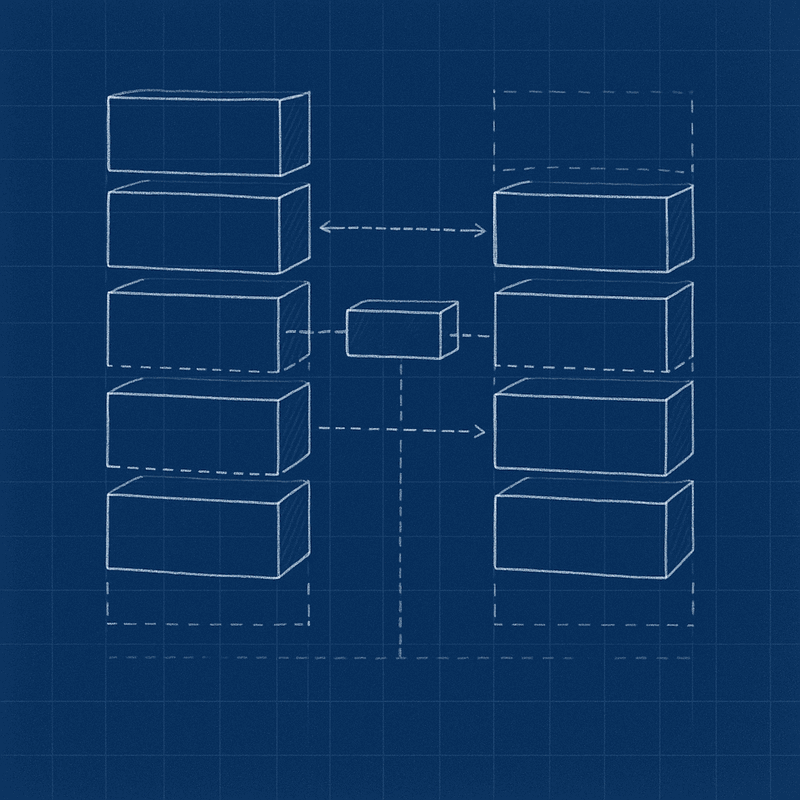
Team A owned authorization processes at the business layer, authorization applications at the application layer, and consumed platform authentication services at the technology layer. Team B owned permit processing at the business layer, permit applications at the application layer, and consumed platform database services at the technology layer. The visualization made something immediately obvious: both teams depended on platform services, but they had never explicitly coordinated their infrastructure requirements.
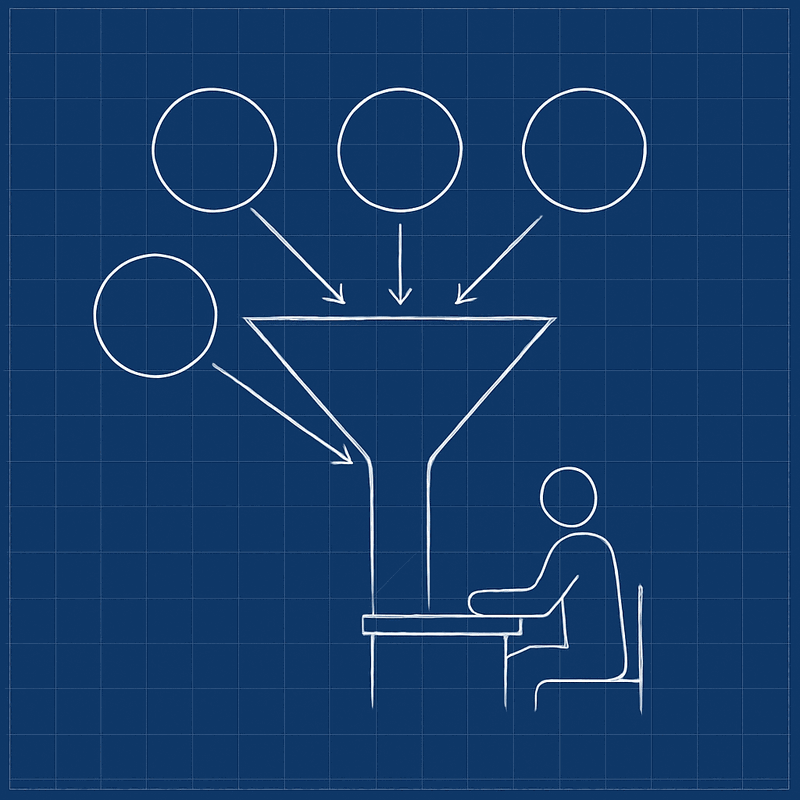
When four teams all depend on the same manual platform processes, the bottleneck becomes impossible to ignore visually. The diagram showed convergent arrows flowing into the platform team's services box. That visual made the coordination problem concrete in a way that months of verbal discussion had not.
The Platform Team Transformation
The most significant outcome of this visualization was the platform team's transformation from what I call "deployment gatekeeper" to "self-service infrastructure provider." Before the visual model, the platform team experienced their role as coordination-heavy. They attended every team's planning meetings. They manually processed deployment requests. They served as the required checkpoint for any infrastructure change.
The ArchiMate model did not critique this pattern. It simply showed it. When you see four teams all routing through a single coordination point, the bottleneck becomes self-evident. The platform team saw their own constraint in the diagram and began asking different questions.
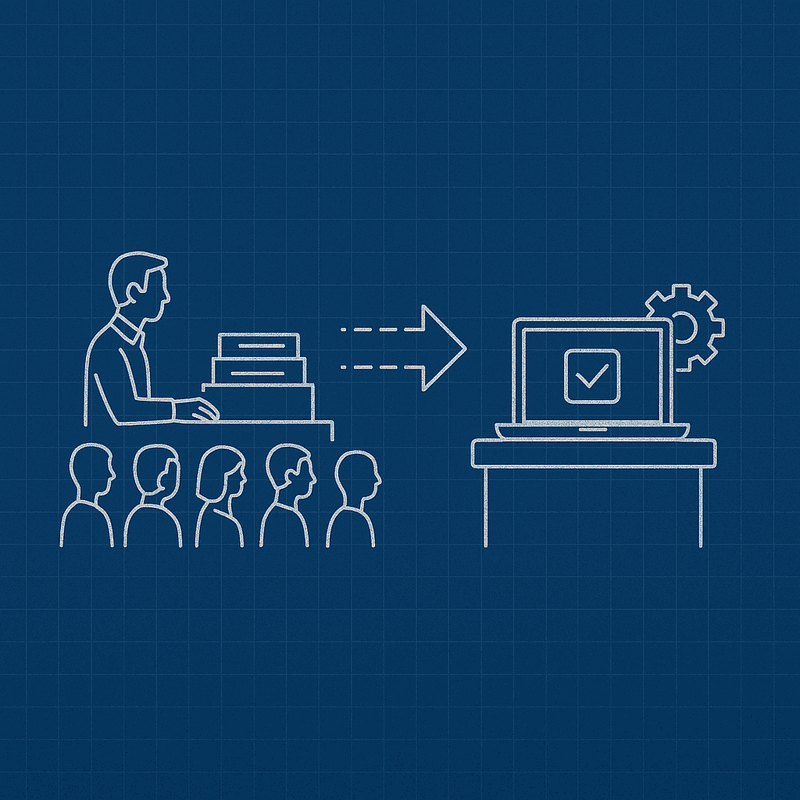
Three changes emerged from that visibility. First, container orchestration became self-service. Teams could provision their own containers through standardized templates rather than waiting for platform team approval. Second, deployment pipelines became team-owned. Each development team managed their own CI/CD configuration within platform-defined guardrails. Third, monitoring became automatic. Platform services pushed telemetry to teams rather than requiring teams to request monitoring access.
One developer captured the transformation perfectly: "I used to wait three days for platform team approval to deploy a container. Now I provision it myself in twenty minutes using their self-service portal. The ArchiMate model showed them they were the bottleneck. They fixed it by building better services."
The visual model did not just document the architecture. It made the transformation obvious. The platform team shifted from managing requests to building capabilities. Coordination meetings that used to take hours became unnecessary because the coordination was embedded in the platform services themselves.
Results and Metrics
Six months after implementing this three-layer visualization approach, we measured the impact across several dimensions.
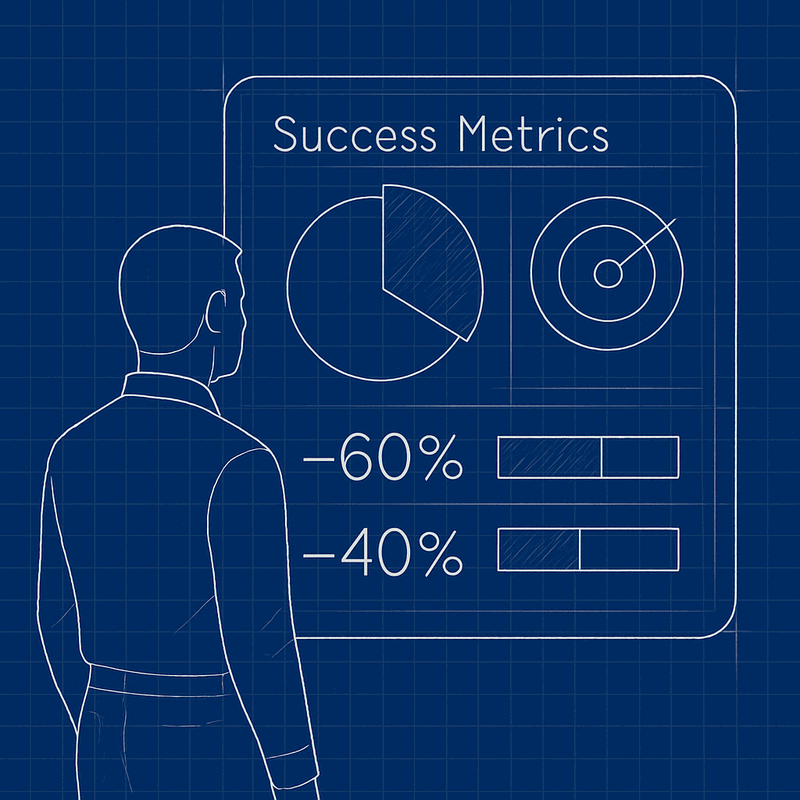
Requirements clarification meetings dropped by 60 percent. When stakeholders could see their concerns represented in the visual model, they required less verbal explanation. Development teams could trace business requirements down to technical implementations without multiple rounds of discussion. Business stakeholders could understand technical constraints by looking at the dependency relationships rather than having them explained repeatedly.
Impact analysis for changes became 40 percent faster. When a business process needed modification, teams could visually trace which applications would be affected and which infrastructure services supported those applications. The guessing and debate that used to accompany change analysis was replaced by visual evidence.
Architecture decisions shifted from being based on whoever talks loudest to being based on visual evidence. This is harder to quantify but perhaps the most significant cultural change. When disagreements arose, teams would update the model and look at the implications together rather than retreating to their corners and defending positions.
The transformation happened because ArchiMate gave everyone a shared language. Business stakeholders could see team responsibilities represented visually. Development teams could see integration points and dependencies. Platform teams could see capacity planning requirements and service consumption patterns. Same information, three perspectives, zero confusion.
Implementation Guide: Your Three-Box Challenge
If you are ready to apply this approach in your own environment, here is a practical exercise to get started. Take one meeting topic that consistently causes confusion or conflict in your organization.
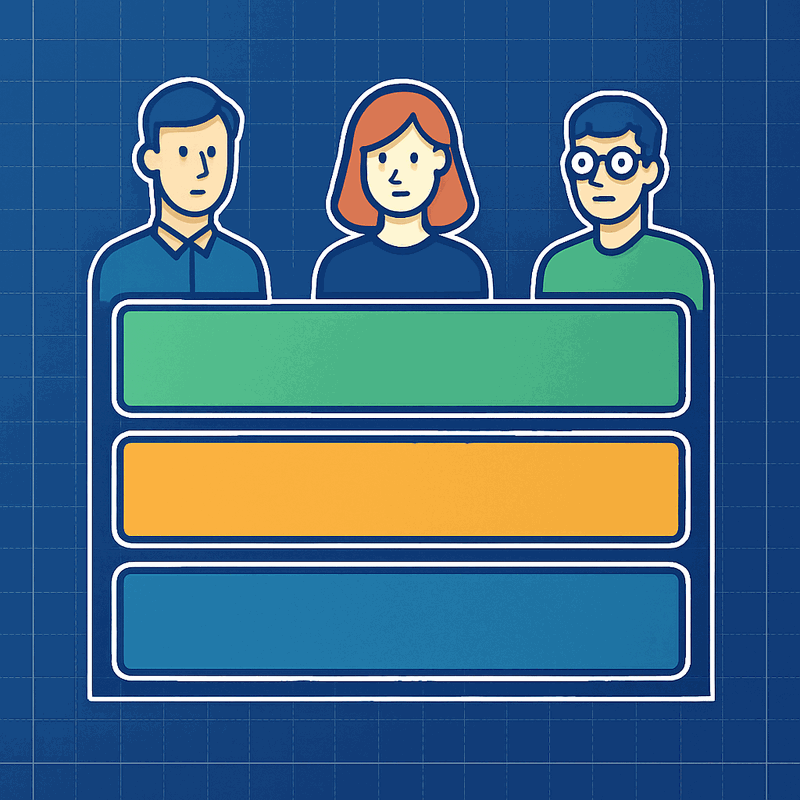
Draw three boxes on a whiteboard or in your preferred diagramming tool. Label the top box "Business Processes." Label the middle box "Applications." Label the bottom box "Technology." These correspond to ArchiMate's business, application, and technology layers, but you do not need formal ArchiMate modeling to begin.
Put team names in the boxes where they have primary ownership. If a team owns a business process, put them in the top layer. If they own applications, put them in the middle. If they own infrastructure, put them at the bottom. Some teams may appear in multiple layers, which is normal.
Now draw the dependency arrows. Higher layers consume services from lower layers. Business processes are supported by applications. Applications run on technology infrastructure. Draw these relationships explicitly.
Here is the diagnostic insight: if you argue about where a box goes or where an arrow points, you have just found a coordination problem that is costing you hours every week. The argument itself reveals the ambiguity that has been causing meeting dysfunction. Make the disagreement visible, and you have taken the first step toward resolving it.
Common Pitfalls and How to Avoid Them
In applying this framework across multiple organizations, I have observed several common mistakes that reduce its effectiveness.
The first pitfall is over-modeling. The three-layer visualization is meant to enable conversation, not replace it. If you spend weeks creating comprehensive ArchiMate models before having stakeholder discussions, you have missed the point. Start with three boxes and a few arrows. Add detail only when the conversation requires it.
The second pitfall is treating the model as documentation rather than communication. The value of this approach is not in the artifact but in the shared understanding it creates. A perfectly accurate model that no one looks at provides no coordination value. An imperfect model that teams reference daily transforms how they work together.
The third pitfall is architect ownership. If the architect owns the model and updates it in isolation, you have recreated the translation bottleneck I described earlier. The model should be collaboratively maintained, with each team responsible for the accuracy of their domain representation.
Connecting TOGAF and ArchiMate Practically
For those familiar with TOGAF, this three-layer approach connects directly to ADM Phase C work in Information Systems Architecture. The business layer corresponds to business architecture artifacts. The application layer corresponds to application architecture artifacts. The technology layer corresponds to technology architecture artifacts.
What ArchiMate adds is the visual notation that makes these relationships communicable across stakeholder groups. TOGAF tells you what to document. ArchiMate shows you how to visualize it in ways that non-architects can understand.
The combination is powerful for practical enterprise architecture work. TOGAF gives you the process and governance framework. ArchiMate gives you the language for stakeholder communication. Together, they turn architecture documentation into architecture conversations that actually produce organizational alignment.
Conclusion: From Chaos to Coordination
The stakeholder meeting chaos I described at the beginning of this article is not inevitable. It is a symptom of missing shared language, not missing expertise. Every team in that meeting room had the knowledge needed to make good decisions. What they lacked was a way to make their knowledge visible to each other.
The Three-Layer Translation Rule provides that visibility through simple visual structure. Business processes at the top. Applications in the middle. Technology at the bottom. Each layer serves the one above it. Each stakeholder group can find their concerns and see how they connect to others.
If you take one thing from this article, let it be this: the next time you find yourself in a meeting where everyone is talking past each other, stop talking and start drawing. Three boxes on a whiteboard can transform an hour of circular discussion into five minutes of productive alignment.
I share this from my experience working on national-scale government systems where architectural decisions ultimately affect citizens. Your context will be different. Your mileage will vary. But the fundamental principle applies universally: when you cannot make stakeholders understand your architecture decisions visually, you will spend your career explaining the same problems in endless meetings instead of solving them.
ArchiMate gave me a way out of that cycle. I hope this framework gives you the same.
Resources
- Watch the Video: ArchiMate Saved My Team Coordination Meetings
- ArchiMate 3.2 Specification
- TOGAF Standard