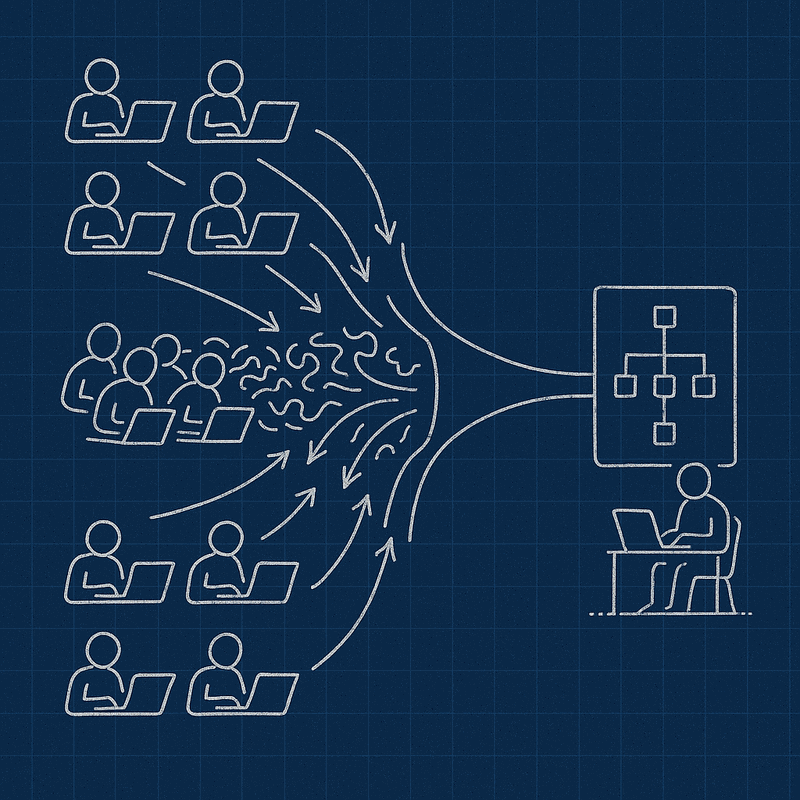
Four development teams. One platform team. Bi-weekly production deployments. Daily coordination meetings that solve nothing. I am the architect who made this worse for six months before discovering what actually worked.
This is the story of how enterprise governance transformed coordination chaos into systematic capability at a large government agency, and the framework I now use to diagnose and resolve team coordination problems without adding more meetings.
If you are an enterprise architect, IT manager, or technical lead managing multi-team environments, this framework will give you a systematic approach to coordination problems. The Architecture Governance Rule I developed from this experience has since been applied across multiple government and enterprise environments with consistent results.
The Perfect Storm of Coordination Failure
Let me paint the picture of what coordination chaos actually looks like at government scale.

Four symptoms revealed deeper problems. Daily coordination meetings that solved nothing. Platform team overwhelmed with manual integration work. Development teams blocked waiting for deployment windows. Twenty-five applications with no clear ownership boundaries.
When enterprise architecture fails at this scale, citizens feel it, not just project dashboards. Permit processing delays. Authorization service outages. Notification failures. Real people waiting for government services while teams argue about who owns what.

The platform team was operating like a single cashier at four different grocery stores during the holiday rush. Every deployment request, every integration question, every configuration change flowed through them. They were not failing at their jobs. They were succeeding at an impossible architecture.
Where I Made It Worse
My first instinct was to become the verbal translator between teams. I would attend every standup, synthesize the discussions, and relay information between groups. I thought I was bridging communication gaps. I was creating a new bottleneck.
For six months, every coordination discussion flowed through me. Teams became dependent on my interpretations. My availability became a constraint on their productivity. My biases colored how information passed between groups.
The breakthrough came when I stopped trying to optimize coordination and started asking why we needed so much coordination in the first place. The answer was not better meetings or better communication. The answer was architectural governance that eliminated most coordination needs entirely.
The Architecture Governance Rule

Here is what eliminated 70 percent of my coordination overhead. I call it the Architecture Governance Rule.
Manual coordination scales linearly with teams. Add one team, add one meeting. Add another team, add another meeting. The coordination overhead grows proportionally with organizational complexity.
Architecture governance scales exponentially with capability. Design it once, every team benefits. Establish clear boundaries once, every interaction becomes predictable. Define ownership once, every dispute has a resolution path.
The shift changes everything. You stop asking "how do we coordinate better" and start asking "how do we design systems so teams need less coordination."
Four Enterprise Principles That Made It Work

Here is what I actually did in this situation. I applied four enterprise principles systematically.
Modularity: Teams operate independently within clear domain boundaries. Each team owns a specific set of capabilities and has full authority within those boundaries. No team needs permission from another team to make changes within their domain.
Interoperability: Teams integrate through standardized interfaces. When Team A needs something from Team B, they use defined APIs and contracts. The integration pattern is predictable and documented, not negotiated per-request.
Security: Enterprise-wide governance maintained across all teams. Certain decisions remain centralized because they affect everyone. Authentication standards, data protection requirements, audit compliance. These are not team-level choices.
Agility: Architecture supports rapid business change. When ministry requirements shift, the architecture enables response without requiring coordination meetings to figure out who needs to do what.
These principles revealed coordination problems I had been blind to. No clear domain boundaries meant every change required negotiation. No standardized integration patterns meant every team interaction was custom. No systematic approach to business requirement distribution meant ministry requests created coordination chaos.
The Three-Level Implementation

If your architecture decisions at different levels contradict each other, you get coordination chaos regardless of good intentions. Here is how we structured governance across three levels.
Enterprise Level: Governance Framework for Team Autonomy
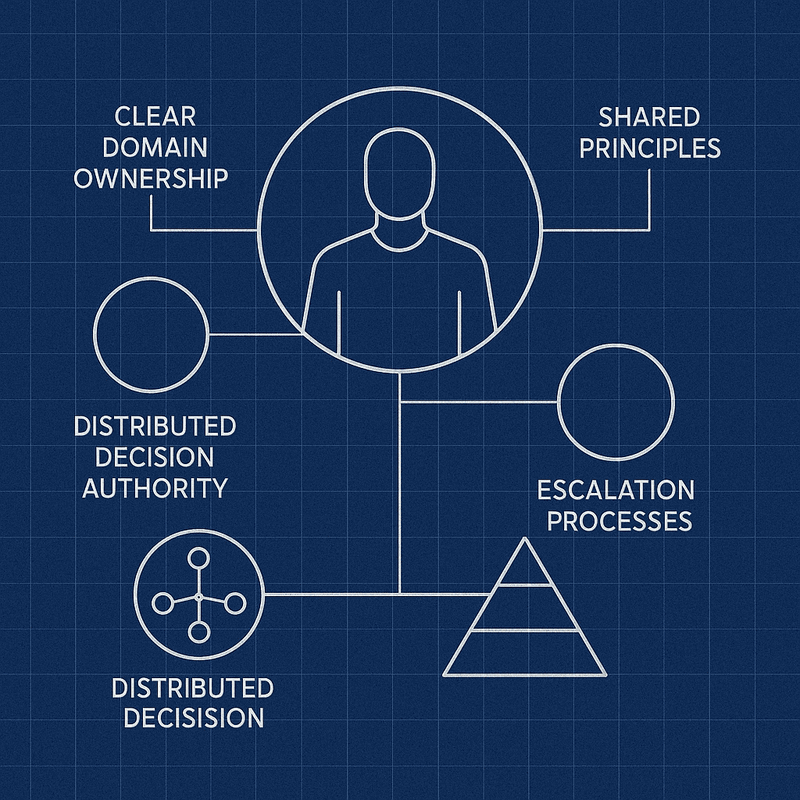
Enterprise level established who decides what. Clear domain ownership defined which teams had authority over which business capabilities. Shared architectural principles provided guardrails without micromanagement. Decision-making authority distributed within boundaries so teams could act without escalation. Escalation processes for cross-domain coordination when genuine conflicts arose.
Application Level: Integration Patterns and Service Boundaries

Application level defined how teams work together. Each team owns specific application portfolio with full development authority. Teams provide services through defined interfaces that other teams can consume. Integration standards enable autonomous development because teams know what to expect from each other.
Technology Level: Platform Services Enabling Independence

Technology level enabled teams to work without waiting. Self-service deployment capabilities meant teams could release without platform team approval. Container orchestration provided consistent environments across all teams. Monitoring and logging gave teams visibility into their own services. Infrastructure services consumed rather than requested.
The Messiest Negotiation

If you are an architect, on paper this looks like clean governance hierarchy. In practice, it was messy negotiations about decision rights, budget authority, and who escalates what to whom.
The messiest negotiation was not about technology. It was about the customer notification service. Business team said it was their domain. Platform team said it was infrastructure. Development Team B said they built it. Three weeks of political arguments with no resolution.
Then we applied the governance framework with one question: "Who makes decisions about notification rules?"
Answer: Business team. They own the domain because they decide what notifications get sent, when, and to whom. Platform provides the infrastructure service that enables notifications. Team B maintains the code under Business domain authority.
Fifteen minutes of framework application versus three weeks of political arguments.
This pattern repeated across our 25 applications. Every ownership dispute resolved the same way. Stop arguing about technical proximity. Start asking about decision authority.
The Breakthrough Insight

Coordination overhead reduces dramatically when architectural design addresses team interaction patterns systematically. Instead of optimizing broken coordination, you redesign the system so teams need less coordination.
The dataset inventory analysis exposed the real issue. Thirty-four gigabytes across six different storage technologies. Shared data systems creating dependencies between teams. Backup strategies requiring cross-team coordination. Like having four different filing systems for the same documents.
When we mapped data ownership to team boundaries, the coordination requirements became visible. Some data clearly belonged to specific teams. Some data was genuinely shared and needed governance. Most of the coordination meetings existed because nobody had ever made these decisions explicit.
Results and Metrics
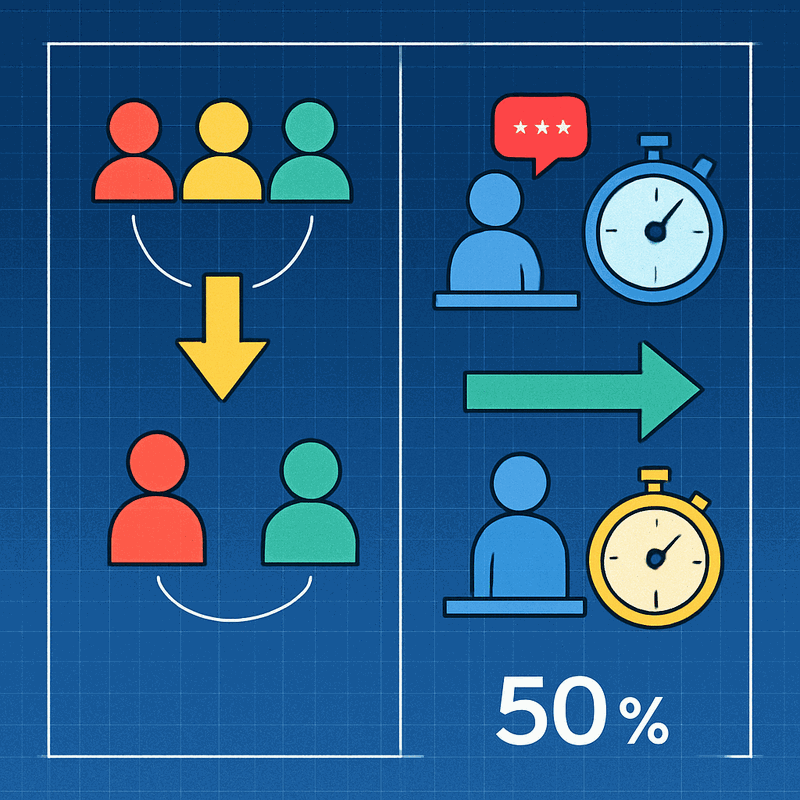
Six months later, the numbers told the story. 70 percent reduction in coordination overhead. 50 percent faster decision-making cycles. Teams operating autonomously within clear architectural boundaries.
The IT Manager captured it best: "We went from 15 coordination meetings per week to 4. The other 11 were eliminated because teams now have clear domain boundaries and standardized interfaces. Your governance framework gave us back 44 hours of productive time weekly."

If you are a manager, this translates directly to business value. Architecture capability that scales with organizational growth rather than manual intervention. Platform team focused on capability development rather than crisis management. Teams empowered to deliver without waiting for coordination approval.
Cultural Transformation Through Design

The cultural transformation happened through architectural design rather than motivational speeches. Teams gained autonomy within clear boundaries. Enterprise coherence maintained through shared principles rather than central control. Business alignment achieved through governance rather than manual oversight.
What surprised me most? Technical coordination became straightforward once enterprise architecture established clear domain boundaries. Team coordination shifted from crisis management to routine architectural decision-making.

The ownership arguments at 3 AM stopped happening. Not because people became more agreeable, but because the architecture made ownership explicit. When something breaks, teams know who owns it. They contact that team directly instead of scheduling a coordination meeting.
Your Three-Level Challenge

If you want to apply this in your environment, here is a practical exercise. Take one recurring cross-team escalation from your organization.
Label it. Is this an enterprise principle problem? A domain boundary problem? A platform service problem?
Then decide one change at that level. Not three changes. Not a complete governance overhaul. One change that addresses the root level of the problem.
Here is the diagnostic insight. Most coordination meetings exist because one of these levels is broken. Daily standups where three teams mention the same API but nobody knows who owns it? That is an application level problem with unclear domain boundaries. Platform team overwhelmed with deployment requests? That is a technology level problem with missing self-service capabilities.

Remember the Architecture Governance Rule. Manual coordination scales linearly with teams. Architecture governance scales exponentially with capability. Design it once, every team benefits.
Common Implementation Pitfalls
In applying this framework across multiple organizations, I have observed several patterns that reduce its effectiveness.
The first pitfall is attempting comprehensive governance design before starting. You do not need perfect governance to begin. You need clear principles that teams actually follow. Start with one domain boundary dispute. Resolve it using the framework. Build credibility through demonstrated results.
The second pitfall is treating governance as documentation rather than decision rights. A governance document that nobody references provides no coordination value. The power is in having explicit answers to "who decides" questions, not in comprehensive diagrams.
The third pitfall is centralizing all governance authority. The goal is distributed decision-making within clear boundaries, not central control. If every decision still flows through a governance board, you have replaced coordination meetings with approval meetings.
Connecting TOGAF and Practical Governance
For those familiar with TOGAF, this approach connects directly to the Preliminary Phase and Phase A work. The Preliminary Phase establishes architecture capability and governance. Phase A creates architecture vision including team interaction patterns.
What makes this practical is focusing on decision rights rather than artifact production. TOGAF provides the framework for thinking about governance. The Architecture Governance Rule provides the principle for implementation: design governance that eliminates coordination rather than optimizing it.
Conclusion: From Crisis to Systematic Capability
The coordination crisis I described at the beginning was not a people problem or a process problem. It was a governance problem masquerading as both.
Every team in those endless meetings had the expertise to make good decisions. What they lacked was clear authority to make those decisions without coordination. The architecture was forcing human coordination that should have been embedded in system design.
If you take one thing from this article, let it be this: the next time you schedule a coordination meeting, ask whether the underlying governance problem could be solved instead. Three levels to check: enterprise principles, domain boundaries, platform services.
Design it once. Every team benefits. That is the Architecture Governance Rule.
I share this from my experience working on national-scale government systems where architectural decisions ultimately affect citizens. Your context will be different. Your mileage will vary. But the fundamental principle applies universally: governance that eliminates coordination scales better than coordination that manages chaos.
Resources
- Watch the Video: Enterprise Architecture - The Team Coordination Crisis
- TOGAF Standard - Architecture Governance
- Enterprise Architecture Frameworks Overview
Watch the video for the personal stories and specific examples behind this framework: Enterprise Architecture - The Team Coordination Crisis
Which level of coordination problem causes the most friction in your organization: enterprise principles, domain boundaries, or platform services? Share in the comments, and I will suggest how the three-level framework might help.
Continue Reading
Want the full implementation guide? This article shares the personal story. For the complete step-by-step framework with phases, metrics, and pitfalls, read the companion piece:
Solving the Enterprise Architecture Team Coordination Crisis: From Chaos to Systematic Governance →
Related articles: