Introduction
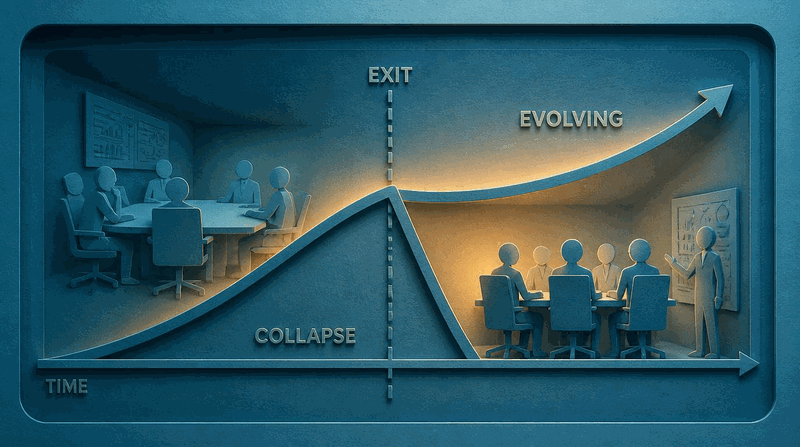
Most architects treat handover as a final act: a document produced in the last two weeks of an engagement, thorough by intention, and complete by the time the exit meeting ends. In my experience, that framing is where most architecture knowledge transfer fails, not because the documents are poor, but because the architecture was never designed to be handed over in the first place.
This article expands on my video about architect handover, which tells the story of a fifty-page document I produced at the end of a multi-year engagement and the quiet collapse that followed six months later. The video approaches the topic through that personal failure. This article develops the underlying discipline more fully: what Handover-as-Design-Constraint means in practice, why it must begin in Week 1 rather than Month 22, and how a private instrument called the successor persona makes the discipline operational on a daily basis.
This is written for architects at any level who are currently building something they will eventually leave. It is equally relevant to senior developers who carry architectural knowledge that is not yet formalised, and to IT managers who have watched architecture decay after a key person rotated out. The question at the centre of all of it is the same: are you building architecture that survives you, or architecture that requires you?
Why architect handover fails before it begins
The standard model of architect handover assumes that knowledge transfer is a communication problem. If the departing architect documents thoroughly enough, the successor will understand the work. This assumption produces better and better documents while the underlying problem remains untouched.
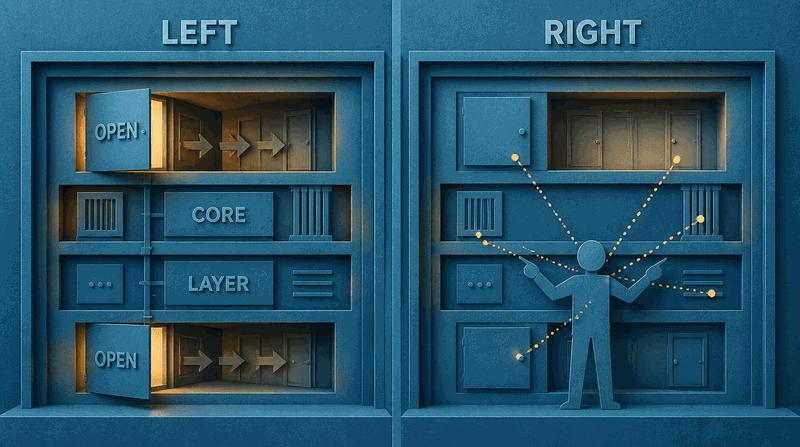
Knowledge transfer in architecture is not primarily a communication problem. It is a structural problem. The patterns a team uses, the governance rituals they run, the decision records they consult: none of these survive a transition simply because they are documented. They survive because the team has internalised them, owns them, and can operate them without the original architect present to explain the reasoning. Documentation can support that ownership, but it cannot substitute for it.
In my experience, the gap becomes visible in a specific and predictable sequence. Patterns get quietly abandoned, not challenged or replaced, because nobody else has ever explained them in their own words. Governance rituals disappear because they were running on the departing architect's calendar and the successor did not know they existed. Decision records remain in the repository, untouched, because the team has defaulted to asking the new architect rather than consulting artefacts that feel like someone else's property. Each of these failures looks like a people problem or a process problem at the surface. Underneath, it is an architecture design problem.
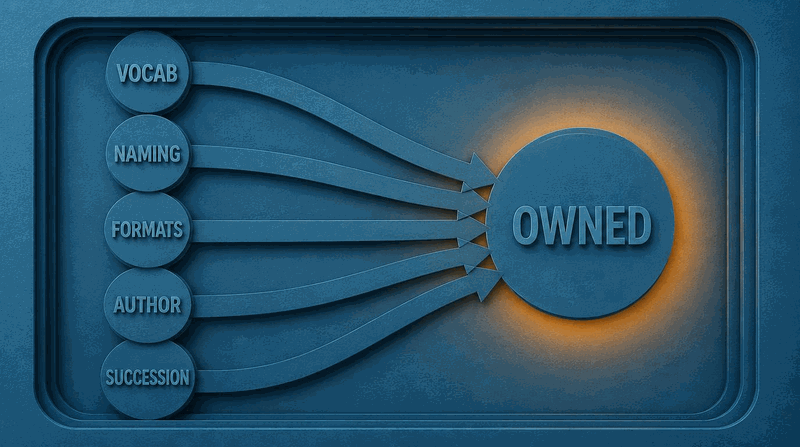
The five failure modes I observed in my own engagement, and have since recognised in others, all originate in the same upstream gap. Vocabulary fidelity was absent: the artefacts used the architect's preferred terminology rather than the team's language, making them feel imported rather than owned. Named concepts were formalised before the team had begun using them spontaneously, so the names did not survive the architect who chose them. Artefact formats required tooling the team did not have, making updates impossible without the original author. Knowledge was concentrated in a single author because writing alone was faster. And decisions were never designed as if a successor would inherit them, so the rationale lived in the architect's head rather than in the work itself.
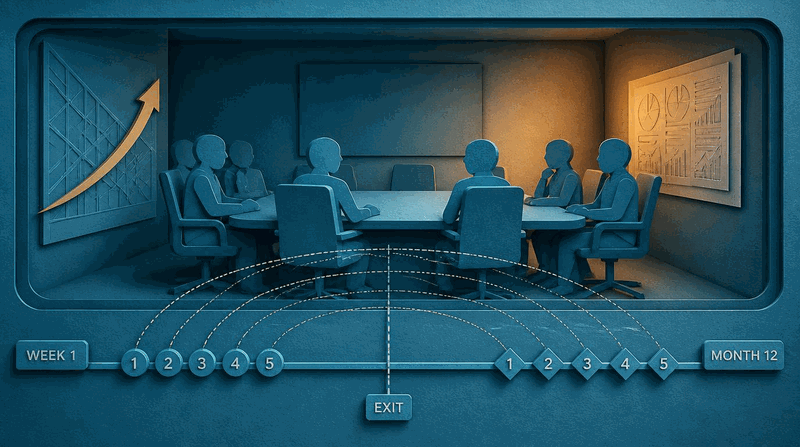
None of these failures are visible at the moment they occur. They look like reasonable efficiency choices under delivery pressure. Their consequences only become visible six to twelve months after the architect has left, which is precisely why the discipline that prevents them must begin in Week 1, not in the final month. The checklist at the end of an engagement is not the wrong tool for the wrong problem. It is the right tool applied twelve months too late.
Handover-as-design-constraint: the five upstream moves
Handover-as-Design-Constraint is the discipline of treating architect succession not as an event triggered by exit, but as a constraint engineered into every decision throughout the engagement. It is not a methodology or a process layer. It is a set of five specific upstream design moves, taken in the first eight weeks of an engagement, whose effects accumulate quietly across months and become visible only when the architect is no longer present.
Vocabulary fidelity
Architects tend to arrive in an engagement with a working vocabulary shaped by previous contexts, preferred frameworks, and personal mental models. Using that vocabulary in artefacts, decision records, and named patterns creates a subtle but durable problem: the language signals that the work belongs to the architect, not to the team.
Vocabulary fidelity means using the team's words, including their idiosyncrasies and imprecisions, in preference to your own. When the team calls something a "pipeline check" and you would call it a "pre-deployment validation gate," the artefact should say "pipeline check." The cost is a small loss of terminological precision. The gain is that the team can read, explain, and update the artefact without translating it back into their own language first.
This move feels uncomfortable early in an engagement when the team's vocabulary is inconsistent or technically imprecise. In my experience, the discomfort is worth accepting. An artefact written in the team's language is one the team will consult. An artefact written in the architect's language is one the team will reference once and then route around.
Named-concept stability
Architects name things. Naming a pattern, a principle, or a governance concept is part of how architectural thinking becomes communicable. The timing of that naming, however, determines whether the name survives the architect.
Named-concept stability means waiting until the team is already using a concept spontaneously before formalising a name for it. When the team begins describing a recurring pattern in their own words, across multiple conversations and without prompting, that is the moment to propose a name and formalise the concept. The name then emerges from the team's usage rather than being imposed by the architect. Teams adopt names they feel they participated in creating. They tolerate names they were handed.
The cost of this move is patience. There will be concepts the architect can see clearly in Week 3 that the team will not begin using spontaneously until Week 10. Waiting is genuinely slower. In my experience, the alternative is faster in the short term and invisible in the long term: the concept disappears from the team's practice the moment the architect who named it is no longer present to reinforce it.
Reproducible artefact formats
Every artefact an architect produces carries an implicit assumption about who will update it. If the format requires specific tooling, a particular diagramming application, or a template that only the architect has configured, then the implicit assumption is that the architect will update it. That assumption becomes a structural dependency.
Reproducible artefact formats means choosing formats the team can update without the architect's specific tooling, even when that choice costs polish. A decision record in a plain text format that any team member can edit is more durable than a beautifully formatted document that requires a proprietary template to modify. An architecture diagram in a format the team's standard tooling can open and edit is more durable than one produced in a tool the team does not use.
The trade-off is visible and immediate: the artefacts will be less elegant than they could be. I have found this genuinely difficult to accept under delivery pressure, when producing a polished artefact feels like evidence of quality. The discipline requires accepting that a less polished artefact the team can maintain is more valuable than a polished one they cannot.
Distributed authorship
Writing alone is faster. In the early weeks of an engagement, under the pressure of establishing credibility and delivering visible output, the temptation to produce artefacts alone is significant. The problem is that knowledge written by a single author is owned by that author. When the author leaves, the knowledge leaves with them in a form the team cannot reproduce.
Distributed authorship means co-authoring artefacts from Month 2 onward, even when writing alone would be faster. This does not require formal pair-writing on every document. It means involving team members in the drafting process: asking a team lead to write the first draft of a decision record and then reviewing it together, asking a developer to document a pattern they have been using and then formalising it jointly. The goal is that the team has been inside the thinking, not just handed the output.
The cost is time, consistently, across the engagement. In my experience, the return is that the team's ownership of the artefacts is genuine rather than nominal. When the architect leaves, the team does not experience the artefacts as abandoned property. They experience them as their own work, which they continue to maintain.
Successor anticipation
The fifth move is the most consistently difficult to sustain. Successor anticipation means designing every decision as if a specific person will inherit it in twelve months. Not a generic future architect, but a specific imagined person with a defined seniority level, a particular domain background, a known tooling familiarity, and a real political situation in the organisation.
This move changes the character of decision rationale. When a decision is designed for a specific successor to inherit, the rationale must be explicit enough that the successor can understand not just what was decided but why, what alternatives were considered, and what constraints shaped the choice. Decision records written with successor anticipation active are materially different from those written without it. They contain the reasoning, not just the conclusion.
The cost is a question added to every decision: could the persona operate this without me explaining it? That question, applied consistently, slows every decision by a small margin. The accumulated effect across an engagement is an artefact set that is already in handover form before the handover event begins.
The relationship between the five moves
These five moves are not independent. Vocabulary fidelity makes artefacts readable by the team. Named-concept stability makes the artefacts' concepts adoptable. Reproducible formats make them maintainable. Distributed authorship makes them owned. Successor anticipation makes the rationale recoverable. Each move reinforces the others, and the absence of any one of them creates a gap that the remaining four cannot fully close.
In the engagement I examined in retrospect after my own failure, all five were absent. In the engagement I ran immediately after that lesson, all five were present from Day 1. The architecture from that second engagement was still operating four years after I left, adapted by the team in directions I would not have chosen. That adaptability, the team modifying the work rather than abandoning it, is the success criterion the five moves are designed to produce.
Implementing the successor persona from Day 1
Understanding the five moves as a framework is one thing. Having a daily instrument that makes you apply them is another. In my experience, the gap between understanding a discipline and practicing it consistently is where most good intentions fail under delivery pressure. The successor persona is the instrument that closes that gap.
What the persona is and how to construct it
The successor persona is a private, written description of an imagined person who will inherit the architecture in twelve months. It is not a public artefact and does not need to be shared with the team. Its only function is to give the five upstream moves a concrete reference point for every decision.
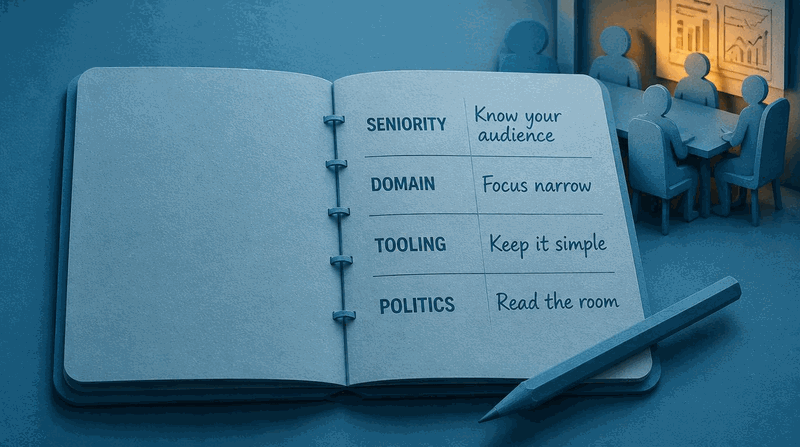
Write the persona on the inside front cover of your working notebook, or in the first page of your working notes file, somewhere you will see it every time you begin a working session. The persona should specify four things: seniority level, domain background, tooling familiarity, and political situation in the organisation. A useful persona might read: "Mid-level architect, strong in application patterns, limited infrastructure depth, unfamiliar with the governance tooling this team uses, inheriting into a unit that has had three architects in four years and is sceptical of new frameworks."
That level of specificity changes how you write a decision record. It changes which terms you define explicitly. It changes which assumptions you surface rather than leave implicit. It changes whether you include the alternatives you considered or only the conclusion you reached.
Using the persona under pressure
The persona is most valuable under exactly the conditions when it is hardest to use: when delivery pressure is high, when writing alone would be faster, when the temptation to produce a polished artefact in your preferred tooling is strongest. The discipline is not to eliminate those pressures but to route the five questions through the persona before each decision becomes final.
The five questions are: Would the persona understand this term, or does it need to be in the team's language? Would the persona adopt this concept name, or would they invent their own? Can the persona update this artefact without my tooling? Has the persona been part of producing this, or only handed it? Can the persona read this decision and understand why it was made without asking me?
Each question takes thirty seconds to ask. The cumulative effect across an engagement is an artefact set that has been shaped, consistently, by a successor's perspective. When a real successor is eventually named, update the persona to match them and continue the discipline unchanged. The transition from imagined to real successor requires no change in the instrument, only a revision of its parameters.
Common failure modes in applying the discipline
The most common failure is applying the persona selectively, to formal artefacts but not to working decisions. In my experience, the decisions that most need successor anticipation are the informal ones: the verbal agreement in a governance meeting, the pattern that the team begins using before it is documented, the constraint that the architect holds in memory because it has not yet needed to be written down. The persona discipline applies to those decisions first, because they are the ones most likely to be invisible to a successor.
The second common failure is abandoning the discipline when the engagement is going well. A healthy, capable team generates confidence that the knowledge is distributed. That confidence is frequently wrong. The team's capability during the engagement reflects the architect's presence. The test of distributed knowledge is what happens six months after the architect leaves, and that test cannot be run in advance.
Measure success by two criteria: whether the knowledge transfer at the end of the engagement takes less time than expected, and whether the architecture is still being used and adapted twelve months after departure. Both are lagging indicators, which is why the discipline must be practiced as a leading constraint from the start.
Designing architecture that outlasts the architect
The distinction between an architect who completes an engagement and an architect whose work survives the engagement is not a distinction of technical quality. In my experience, it is a distinction of design intent. The architecture that came apart six months after I left was not poor architecture. It was architecture that had not been designed to be inherited. The architecture that was still operating and evolving four years after I left was not significantly more sophisticated. It had been designed, from the first week, as if replaceability were a structural requirement.
The successor persona and the five upstream moves are not a guarantee. Every engagement context is different, and the moves will land differently depending on team maturity, organisational culture, and the political situation the successor inherits. Your mileage may vary. But the underlying question does not change regardless of context: could the person who inherits this work operate it without you present to explain it?
If you take one thing from this article, make it this: write a successor persona before your next engagement decision. One imagined person. Their seniority, their background, their tooling familiarity, their political situation. Put it where you will see it every time you open your working notes. Then ask, for every decision you make this week, whether that person could operate it without you explaining it. The answer to that question, applied consistently across an engagement, is what Handover-as-Design-Constraint actually feels like in practice.
If you have experienced an architecture collapse after a key person left, or if you are currently building something you know you will eventually hand over, I would be interested in what patterns you have seen. Share your experience in the comments, or bring the question to the discussion under the video.