Introduction
The standard advice for architects stepping into a new seat is to listen first, build relationships, and earn trust before moving. That advice is not wrong. What it omits is that the seat itself carries a shape before you sit in it, formed by whoever occupied it before you. Arriving without reading that shape is one of the more costly onboarding mistakes I have made in my career, and I have made it more than once.
This article expands on my video about the Empty Chair, where I work through the personal experience that produced this diagnostic. Here, I want to give you the structured version: a two-part protocol you can apply in your first two weeks, and the discipline that prevents the most common failure mode once you have the information.
The audience for this is architects and senior engineers who are transitioning into a new role, joining a new team, or taking on an engagement where someone held the equivalent position before them. If the seat has ever been occupied, this pattern applies. The stakes are highest in the first sixty days, which is exactly when most practitioners are focused on technology and roadmap rather than on the political terrain they have inherited.

Why the shaped seat matters for stakeholder mapping
When an architect leaves a role, the stakeholders who worked with that person do not reset. They carry forward a read on the role itself: what it produced, where it fell short, which decisions it owned poorly, and which relationships it failed to build. That read is not documented anywhere. It does not appear in the job description, the onboarding plan, or the kickoff presentation. It lives in the interpretive frame that every stakeholder applies to your first moves, whether you know it or not.
In my experience, this matters most in three specific situations. The first is when the predecessor left under ambiguous circumstances: a lateral move, a quiet departure, or a role that was technically vacant while several people informally covered parts of it. The second is when the predecessor was technically strong but politically difficult, because the team will be watching your first decisions for signs of the same pattern. The third is when the predecessor was well-liked but ineffective in specific areas, because the team will be hoping for correction without wanting to feel disloyal to someone they respected.
All three situations share a structural problem: the stakeholders you are inheriting have already formed expectations about what the role does and does not do, and those expectations were shaped by someone who is no longer in the room. Your first actions will be interpreted through that frame, not through the neutral frame you are assuming you have.
The practical consequence is that stakeholder mapping cannot wait until Month 2. It is not a relationship-building activity that follows technical onboarding. It is the first diagnostic you need to run, because every technical decision you make in the first sixty days will be read through the lens of the predecessor's record. An architect who understands that terrain can navigate it deliberately. An architect who does not will relitigate battles they did not know had already been fought, and lose credibility in ways that are difficult to trace back to their actual cause.
The Empty Chair is not a metaphor for absence. It is a metaphor for the shape the absence left behind. That shape is legible if you know how to read it, and illegible if you assume the seat is neutral.

The Empty Chair protocol: a two-part diagnostic
The diagnostic has two components. The first is a structured stakeholder interview process I call the three-witness protocol. The second is the discipline that prevents you from misusing what you learn.
The three-witness protocol
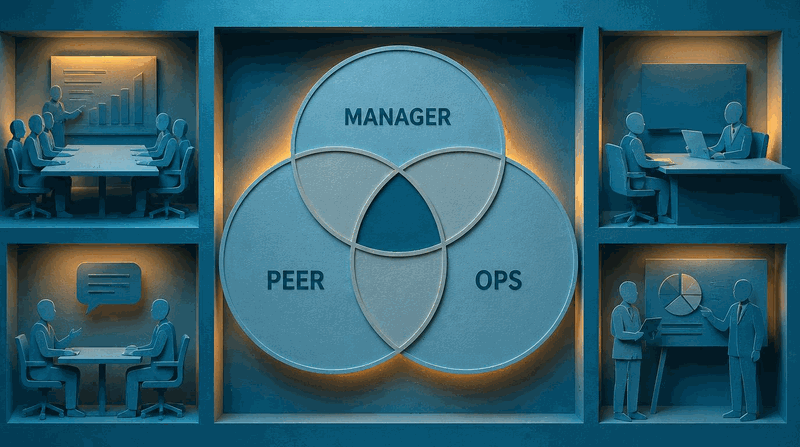
In my second week in the engagement I describe in the video, I asked three people the same question, separately, in private, in three different conversational settings. The three witnesses were the hiring manager, a peer architect who had been in the unit longer than the predecessor, and a downstream consumer of the predecessor's work in the operational team.
The question was identical each time: "Tell me about the last person who held this seat. What did they do well, what did they not get to do, and what would the team hope someone genuinely new does differently?"
Selecting the right three witnesses matters. The hiring manager gives you the institutional view: what the role was supposed to deliver and where it fell short against that expectation. The peer who predates the predecessor gives you the collegial view: how the predecessor operated within the team, which relationships they built and which they neglected, and where the political fault lines ran. The downstream consumer gives you the operational view: what the role actually produced at the point of delivery, independent of what it was supposed to produce or how it was perceived internally.
These three vantage points are structurally different, and that structural difference is the diagnostic value. Each witness entered the same situation through a different door. Each account is accurate within its frame of reference and incomplete outside it. The shape of the inherited terrain becomes visible not from any single account, but from the gaps and contradictions between them.
In the engagement I describe, the three accounts amounted to three different predecessors. The hiring manager described someone technically strong but politically clumsy. The peer described someone politically careful but not technically aggressive enough. The downstream consumer described someone whose proposals had been largely irrelevant, because the predecessor had never visited the operational teams. None of those three descriptions was wrong. None of them was sufficient on its own. Held together, they mapped the terrain precisely: I knew which topics carried political residue, which relationships had been neglected, and which stakeholders were hoping for something the predecessor had not delivered.
The question that carries the most diagnostic weight is the third one: what would the team hope someone genuinely new does differently? Most practitioners avoid this question because it sounds like an invitation to criticise a colleague. It is actually the most forward-facing question you can ask. It surfaces what the team is hoping for, not just what went wrong. That distinction matters because it tells you where genuine appetite for change exists, which is different from knowing where failures occurred.
I sat with that question for two days before I asked the first version of it. I was uncertain whether it would land as professional curiosity or as political positioning. In my experience, the framing is everything. Asking it as a question about the team's hopes rather than the predecessor's failures keeps the conversation forward-facing and reduces the risk that the witness interprets it as an invitation to be disloyal.
Timing and witness selection in practice
The two-week window is not arbitrary. By the end of Week 1, you will have observed enough in meetings to know which topics produce discomfort and which relationships carry tension. That observational data gives you the context to interpret what your witnesses tell you. Without it, the accounts are harder to anchor. With it, you will recognise the terrain your witnesses are describing because you have already seen fragments of it in action.
If one of your three witnesses is not available within the two-week window, do not substitute a more available person from the same vantage point. The three vantage points are not interchangeable. A second peer account does not replace a downstream consumer account. Wait for the right witness, or note the gap explicitly and treat that vantage point as unread terrain until you can fill it.
The protocol does not require formal interviews or scheduled sessions. In my experience, the most candid accounts come from informal settings: a conversation at the end of a working session, a brief exchange before a meeting starts, a short walk between buildings. Formal settings signal that the conversation is on the record, which tends to produce more guarded responses. The goal is a genuine account, not a documented one.
Reading the gaps between accounts
Once you have all three accounts, the analytical step is to identify where they do not align. Disagreements between witnesses are not noise to be resolved. They are signal. A topic that the hiring manager describes as a technical failure but the peer describes as a political one is telling you that the failure had multiple interpretations, which means any move you make in that area will be read differently by different stakeholders. A relationship that appears in the downstream consumer's account as neglected but does not appear in the hiring manager's account at all is telling you that the hiring manager may not have visibility into that gap, which affects how you raise it.
The goal of this analysis is not to determine which account is correct. It is to build a map of the terrain that accounts for all three perspectives simultaneously. That map is what makes the rest of your first sixty days navigable. Without it, you are making architectural and stakeholder decisions on the assumption that the seat is neutral. With it, you are making them with a read on the political residue you have inherited.
In my experience, the three-witness protocol surfaces terrain that no formal onboarding process would reveal, because formal onboarding is designed to communicate what the role is supposed to do, not what the previous occupant's record means for how your first moves will be interpreted. Those are different problems, and they require different diagnostics.
Implementation guide: applying the protocol without overcorrecting
The most common failure mode after running the three-witness protocol is to treat the map as a script for performing the opposite of what failed. This is the Overcorrection Trap, and it is worth addressing directly because the diagnostic makes it feel justified.
In the engagement I describe, the downstream consumer told me the predecessor had never visited the operational teams. My immediate instinct was to spend my first month embedded with those teams. That instinct was not architectural judgement. It was performance: a visible correction designed to signal difference from the predecessor. The problem with performance is that it reads as political rather than technical. The moment a team interprets your moves as narrative management rather than problem-solving, your credibility shifts in a direction that is difficult to reverse.
The discipline the protocol requires is this: use the map to avoid inherited traps, not to perform inherited corrections. The map tells you which moves will silently relitigate battles the predecessor already lost. It does not tell you which opposite moves to make conspicuously. What it tells you is where to act on present-tense judgement without the political residue that would otherwise attach to those actions.
In practice, this means three things. First, never name the predecessor in conversations with the operational teams or downstream consumers you are building relationships with. The relationship you are building is grounded in the present work, not in implicit comparison to someone who is no longer in the seat. Second, let the team notice the difference themselves rather than narrating it for them. In my experience, the signal lands more credibly when it is observed rather than declared. Third, when you act in an area the predecessor neglected, frame it as curiosity about the work, not as correction of a gap. The framing keeps the action grounded in the present rather than in the predecessor's record.
The success metric for the first sixty days is not how many visible corrections you have made. It is whether the stakeholders who matter most are reading you as architecturally serious rather than politically motivated. That distinction is harder to measure than a list of actions taken, but it is the one that determines whether your subsequent decisions are received as technical judgements or as moves in a political game. If you are not sure which way you are being read, the three-witness protocol can be run again at the sixty-day mark with a different question: not what did the predecessor do, but how are your own first moves being interpreted.
The common pitfall to avoid is conflating the map with permission to act quickly. The protocol gives you terrain awareness, not a mandate to move fast. The discipline is to act on present-tense judgement informed by the map, not to use the map as justification for acceleration.

Closing: the seat you inherit is the starting condition, not the constraint
The Empty Chair is not a problem to be solved. It is a starting condition to be read. Every architect who takes a seat that someone else occupied is inheriting a set of interpretive frames that the stakeholders around them will apply to their first moves. The question is not whether those frames exist. They always do. The question is whether you read them deliberately or discover them after the fact, when a decision has already landed badly for reasons you cannot trace.
In my experience, the practitioners who navigate inherited seats well are not the ones who arrived with the strongest plans. They are the ones who spent the first two weeks mapping the terrain before they started moving through it. The three-witness protocol is how I do that mapping now. Your mileage may vary depending on how recently the predecessor left, how candid your witnesses are willing to be, and how much informal coverage the seat received in the interim. But the underlying principle holds across every context I have worked in: three witnesses give you the seat's shape. One witness gives you one witness's interpretation of it.
If you are in a role transition now, or expect one in the next quarter, take fifteen minutes this week and write down three names: the hiring manager, a peer who predates the previous occupant, and someone downstream who consumed that occupant's work. You do not need to have all three conversations immediately. You need the names on a list, because the list is the diagnostic. Watch the video for the personal story behind this analysis: Watch on YouTube
What has your experience been with inherited seats? I am interested in whether the three-witness framing maps to situations you have encountered, or whether your context produced a different set of witnesses worth including.