The AI literacy gap enterprise architects are not talking about
A senior architect with two decades of enterprise architecture experience spent three months trying to fix something that was not broken. When a large language model began producing confident, detailed, and completely fabricated output, he did what experienced architects do: he filed it as a defect and started engineering his way out of it. The problem was not his competence. The problem was that he was applying a deterministic system mindset to a system that was never deterministic.
This article expands on my video about the AI literacy gap, where I walk through this pattern from the inside, including the version of it I ran myself before I recognised what was happening. The video is worth watching if you want the fuller narrative; this article focuses on the framework you can apply directly.
Architectural AI literacy is the discipline of understanding AI's inherent limitations as fixed constraints to design around, not defects to patch away. This article is aimed at enterprise architects, solutions architects, and senior engineers who are being asked to design or govern AI systems and who are finding that existing resources quietly assume a foundation they have not yet been given. If you have ever looked at an AI system's behaviour and reached for a bug report, this is the foundation you are missing.

Why experienced architects get this wrong
The architects who struggle most with AI systems are often the most experienced ones. That is not a paradox. Two decades of deterministic system design builds deeply reliable instincts: find the defect, isolate the cause, apply the fix. Those instincts are correct for the vast majority of systems those architects have ever touched. When they encounter a large language model, the instincts fire exactly as trained, and the result is months of rework that should never have happened.
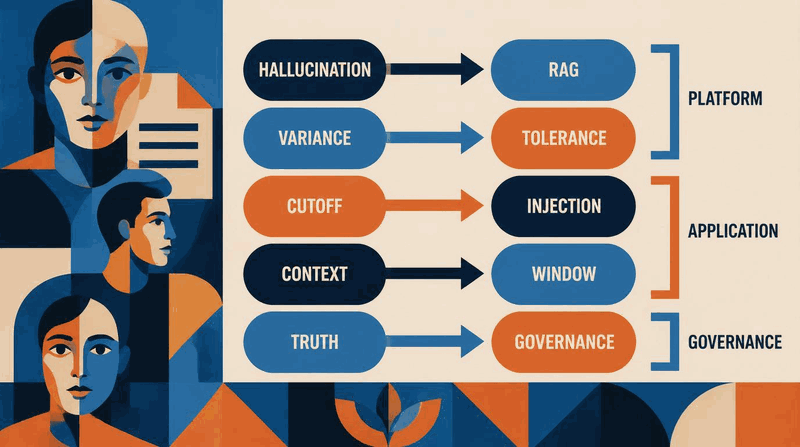
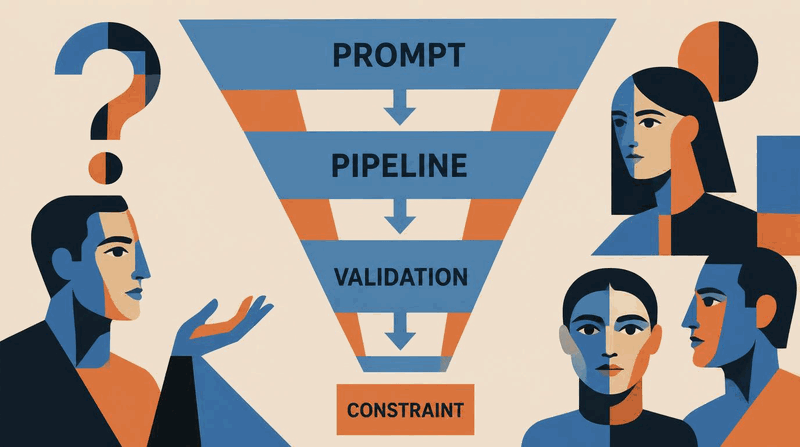
The specific failure mode looks like rigorous quality engineering from the inside. Prompts get restructured. Pipelines get tightened. Output validation gets layered in. Each intervention narrows the symptom. None of them touch the cause, because the cause is not a defect. Hallucination, non-determinism, knowledge cutoff, bounded context, and the absence of an inbuilt source of truth are properties of how these systems work. They are not configuration problems. They will not be tuned away.
I ran this same pattern myself before I recognised it. I kept searching for the parameter, the threshold, the setting that would make the output consistent. What I was actually doing was refusing to accept that the system had a different class of properties than the systems I had spent my career designing. It took seeing the same failure in a colleague's work, from the outside, to name what I had been doing. From the outside it was obvious. From the inside it looked like diligence.
The reason this matters at scale is that AI system deployments are multiplying faster than the foundational understanding needed to govern them. Teams are making implementation decisions in one layer while their reasoning belongs in another. Platform decisions are being made without governance input. Governance is being treated as a compliance wrapper to add after the real engineering is done. The result is ungoverned AI proliferation with a retrofit bill attached, and the bill is consistently larger than the original design would have cost.
The gap is not a skills gap. It is not a tooling gap. It is a literacy gap: a missing conceptual foundation that every implementation resource assumes you already have, and that almost nobody has explicitly provided.
AI architectural constraints and the three-layer framework
The five constraints that matter
Before any framework can help, the constraints themselves need to be named precisely, because vague awareness is not enough to make design decisions.
AI hallucination is the tendency of a language model to generate plausible, confident, and factually incorrect output. The model is not malfunctioning when this happens. It is doing exactly what it was built to do: predict the most statistically likely continuation of a sequence. When that sequence leads toward a fabricated but coherent answer, the model has no internal mechanism to detect the problem.
Non-determinism means the same input does not guarantee the same output. This is not a configuration oversight. It is a fundamental property of probabilistic inference. Systems that assume deterministic behaviour and do not design for variance will surface failures in production that testing never caught.
Knowledge cutoff means the model's training data has a fixed boundary in time. Anything that occurred after that boundary is invisible to the model unless it is explicitly provided in context. For enterprise systems operating in domains where current data matters, this is a structural gap, not a retrieval optimisation problem.
Bounded context means the model can only reason across a limited window of information at once. Requests that require synthesis across large corpora, long histories, or multiple simultaneous documents will exceed that window. The architecture must manage what enters the context window and in what form.
The absence of an inbuilt source of truth means the model has no mechanism to verify its own output against reality. It cannot distinguish between what it knows accurately and what it has confabulated. Verification is an architectural responsibility, not a model capability.
None of these constraints will be engineered away. They are properties. The architecture is the response.
The platform layer
The platform layer is where the model itself lives, along with the infrastructure that serves it. The constraints that bite at this layer are non-determinism and knowledge cutoff.
Non-determinism at the platform layer means tolerance and validation must be built into the serving infrastructure. A system that assumes the model will produce consistent output across repeated calls will behave unpredictably in production. The design move is to build variance tolerance into the serving layer explicitly: retry logic with output comparison, confidence scoring where the model supports it, and downstream validation that does not assume consistency.
Knowledge cutoff at the platform layer means current-data injection must be a platform-level capability. This is not something that can be bolted on at the application layer later. The infrastructure needs to support retrieval pipelines that can bring current, verified data into the context window at inference time. If that capability is not designed into the platform from the start, every application that needs current data will build its own workaround, and the result is fragmented, ungoverned data access patterns across the system.
The application layer
The application layer is where retrieval, grounding, and output handling live. This is where AI hallucination bites hardest, and it is where the most well-known mitigation pattern applies.
Retrieval augmented generation works by retrieving verified source documents and injecting them into the model's context window before generation. The model is then instructed to ground its output in those sources. This does not eliminate hallucination entirely, but it significantly constrains the space in which the model can fabricate, because the model is now working from verified content rather than from statistical patterns alone.
Validation gates are the second design move at this layer. Outputs should be checked against defined criteria before they reach users. What those criteria are depends on the domain and the stakes involved. In a low-stakes informational context, a lightweight consistency check may be sufficient. In a high-stakes operational context, the validation gate may require structured output parsing, rule-based constraint checking, and a human review step for edge cases.
Targeted human review is the third design move. Not every output needs human review, and requiring it universally defeats the purpose of automation. The design question is: for which output categories is the cost of an undetected error high enough to warrant human oversight? Answering that question explicitly, and encoding the answer into the application architecture, is what makes human review a structural property rather than an ad hoc escalation path.
The governance layer
The governance layer is where standards, decision records, and validation policy live. The constraint that belongs here is the absence of an inbuilt source of truth.
Because the model cannot verify itself, the governance layer must carry that responsibility. This is not a soft statement about best practice. It is an architectural consequence of the constraint. If the governance layer does not define what constitutes a verified source, how outputs are validated against it, and who is accountable when validation fails, then no part of the system carries that responsibility. The constraint does not disappear. It simply becomes ungoverned.
Standards at the governance layer function as design-time constraints. They shape what gets built before it is built, not after. A standard that requires all AI-generated outputs touching regulated data to pass through a defined validation gate is a structural constraint on application layer design. If that standard arrives after the application is live, it becomes a retrofit, and retrofits cost more than original designs.
Decision records capture the reasoning behind architectural choices at the time those choices are made. In AI systems, where behaviour is probabilistic and context-dependent, the reasoning behind a design decision is often more valuable than the decision itself. A record that explains why a particular retrieval strategy was chosen, what alternatives were considered, and what failure modes were accepted is a governance asset. A retrospective audit that tries to reconstruct that reasoning six months later is not.
Frameworks such as the NIST AI Risk Management Framework formalise this principle: AI risk management is a design-time input, not a post-deployment activity. Treating it as a compliance wrapper to add after the engineering is done produces ungoverned AI proliferation with a retrofit bill attached. In my experience, that bill is consistently larger than the original governance design would have cost, and the teams who paid it knew it.
Making the layers explicit
The practical value of the three-layer framework is diagnostic. When a design decision arrives, the first question is not "how do we implement this?" The first question is "which layer does this constraint belong to?" A decision about output consistency belongs at the platform layer. A decision about hallucination mitigation belongs at the application layer. A decision about who is accountable for validation failures belongs at the governance layer.
In my experience, teams that make these distinctions explicit before implementation work begins make significantly fewer decisions that have to be revisited. Decisions land in the right layer the first time. The rework that comes from conflating the layers largely disappears. Your situation will differ depending on how mature your existing governance structures are, but the diagnostic question applies regardless of context.

Applying the AI literacy framework in practice
The framework is only useful if it changes what you do before the next architecture conversation. Here is how to apply it concretely.
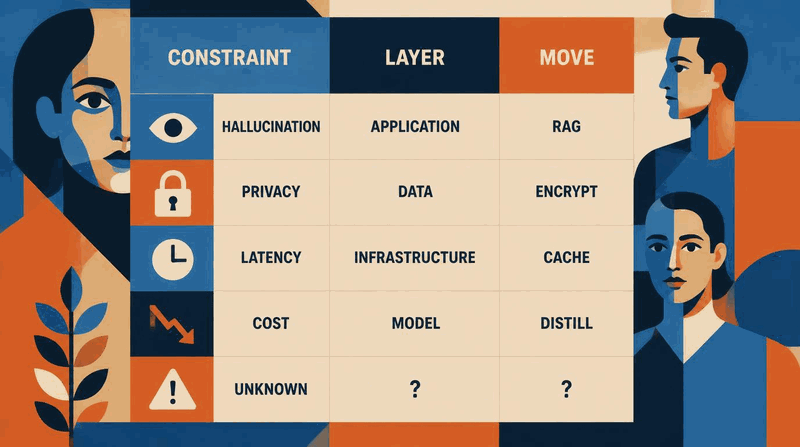
Before any AI system design review, take fifteen minutes and write down the AI limitations that are in scope for the system under discussion. For each limitation, write which layer it belongs to: platform, application, or governance. Then write one design move that absorbs the limitation rather than fights it. The result is a constraint map. Bring it into the conversation. It will immediately surface whether the design is responding to the constraints or assuming they will not appear.
The most common pitfall at this stage is conflating symptoms with constraints. A team that reports "the model keeps giving wrong answers" has identified a symptom. The constraint is hallucination. The layer is application. The design move is retrieval augmented generation plus validation gates. Without that translation, the team will spend time on symptom suppression rather than constraint absorption, which is exactly the three-month loop described at the start of this article.
A second common pitfall is treating governance as a later phase. If the governance layer is not represented in the initial architecture conversation, standards will arrive as retrofits. The cost of retrofitting a governance standard beneath a live AI system is not just the engineering time. It is the period during which ungoverned outputs were in production, the decisions made on the basis of those outputs, and the organisational trust that has to be rebuilt afterward. Governance belongs in the room from day one.
A third pitfall is assuming that platform maturity implies application or governance maturity. A capable platform team can stand up model serving infrastructure ahead of schedule and still leave the application and governance layers completely unprepared. Platform delivery is not a proxy for system readiness. All three layers need to be in place before a system is ready for production use in any context where the stakes of failure are meaningful.
The measure of a well-applied framework is not whether the system behaves correctly in testing. It is whether the architecture was designed to absorb the limitations that will surface in production. Those are different questions, and the second one is the one that matters.
Build the foundation before the floors go up
The architect who spent three months chasing a hallucination bug was not incompetent. He was applying a correct mental model to the wrong category of system. Once he understood that hallucination was a constraint to design around rather than a defect to eliminate, the system he built made sense: retrieval augmented generation, validation gates, targeted human review. That is what architectural AI literacy looks like in practice.
Every advanced pattern in enterprise AI architecture was designed to absorb a specific constraint. Retrieval augmented generation exists because hallucination is a constraint. Validation gates exist because non-determinism is a constraint. Current-data injection exists because knowledge cutoff is a constraint. An AI governance framework exists because the absence of an inbuilt source of truth is a constraint. None of those patterns are arbitrary. None of them make sense unless you understand the limitation they were built to absorb. Literacy is the prerequisite. Everything else is implementation.
Your mileage may vary on which of the three layers needs the most attention in your current context. Some teams have strong governance and a weak application layer. Some have solid platform thinking and no governance at all. The framework does not prescribe a sequence. It gives you a diagnostic.
Start with the constraint map exercise before your next architecture review. Write down the limitations in scope, assign each one to a layer, and identify one design move per constraint. If you find a constraint with no layer assignment and no design move, you have found the gap that will cost you later. Better to find it now.
If this framing is useful, the video walks through the personal stories behind it in more detail: Watch on YouTube. I would be interested to hear which of the three layers is the most underdeveloped in your current AI work. Leave a comment with what you find.