Introduction
A forty-seven page architecture document can be the most thorough, framework-aligned, precisely written artifact you have ever produced, and still answer nothing at the moment someone needs an answer. That is not a documentation quality problem. It is a structural mismatch between what the artifact was built to do and what the organisation is asking it to do.
This article explores that mismatch directly. It introduces the Two-Speed Artifact framework, a way of separating architecture output into two distinct things moving at two distinct speeds, and it offers a diagnostic question you can apply to every artifact you currently maintain. The target audience is anyone who produces or maintains architecture artifacts: developers carrying architectural responsibility, architects at any level, and technical leads who find themselves owning documentation that nobody seems to use.
This expands on my video about living architecture, where I walk through the public sector experience that made the problem impossible to ignore. The video covers the personal story; this article develops the framework in more depth and adds the precision argument that the video introduces but does not fully unpack.
If your architecture documentation exists but does not visibly shape delivery decisions, the Two-Speed Artifact distinction is worth understanding before you write another page.

Why complete architecture documents stop working
The instinct to write thorough architecture documentation is not wrong. Completeness matters for audit trails, for onboarding, and for the formal record of decisions made. The problem is not thoroughness itself. The problem is what happens when a complete document is asked to do a job it was never designed for: answering a specific question under time pressure, at the moment a delivery team is making a decision.
Architecture documents are typically written for a reader who starts at page one, reads linearly, and has enough context to interpret guidance in relation to surrounding sections. That reader exists during formal reviews. That reader rarely exists on a Tuesday morning when a developer needs to know whether a particular integration pattern is permitted under current constraints. The document that serves the first reader poorly serves the second reader, and the second reader is the one whose decisions shape the actual system.
This is not a new observation in technical practice, but it has become more urgent for two reasons. First, delivery cadences have compressed. The time between an architectural constraint being defined and a team needing to apply it has shortened considerably in organisations running continuous delivery. A document that would have been consulted quarterly is now expected to answer questions weekly or daily. Second, automated tooling has entered the delivery loop. AI-assisted development environments, automated compliance checks, and pipeline-integrated validation systems all need to consume architectural constraints at the point of work. Narrative documents are not reliably consumable by these systems, not because they are badly written, but because they are written for human reading rather than machine querying.
The result is a pattern I have seen repeatedly: organisations invest significant effort in architecture documentation, the documentation is formally correct and structurally sound, and it still does not reach the point of decision. Teams work around it, not out of carelessness, but because the artifact cannot answer their question fast enough to be useful. When that happens consistently, architecture stops shaping outcomes. It becomes a compliance exercise rather than a design discipline.
The static document trap is not a failure of effort. It is a failure of artifact design. The document was optimised for the wrong reader at the wrong moment. Understanding that distinction is the first step toward fixing it.
The completeness trap in practice
There is a specific cognitive pattern that makes this trap hard to see from the inside. When you are producing an architecture document, completeness feels like progress. Each section added, each constraint documented, each decision recorded represents work done. The artifact grows more thorough with every iteration, and thoroughness is measurable in a way that usability is not. You can count sections. You cannot easily count the number of times a delivery team could not find what they needed.
I retreated into that pattern during a large public sector infrastructure programme. The document I produced covered every required section. The language was precise. The structure was clean. I kept refining it because refinement felt productive. What I was not measuring was whether the people who needed the architecture could actually use it. The business sponsor's question, "What does this actually change about our work?", was not answerable from the document, because the document had no mechanism for answering questions. It could only be read, and reading forty-seven pages to locate one constraint is not something a delivery team does under pressure.
A document optimised for completeness is optimised for a reader with unlimited time. Architecture artifacts need to serve readers who have neither the time nor the inclination to start from page one.
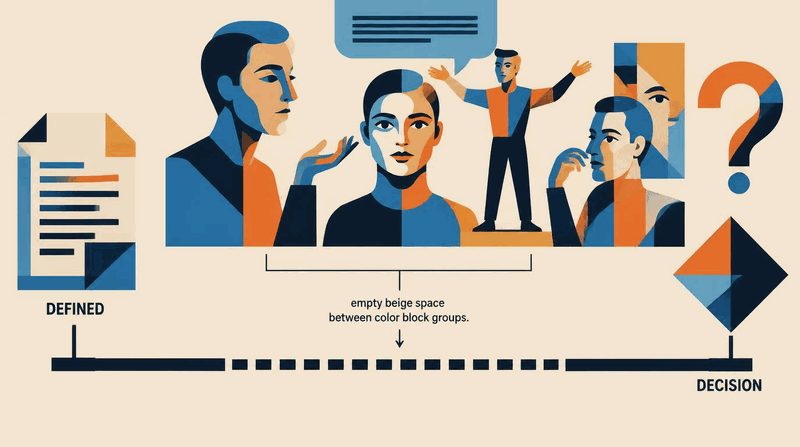
The Two-Speed Artifact framework for living architecture
The Two-Speed Artifact framework makes a single distinction: architecture output separates into two things moving at two different speeds, and they serve fundamentally different purposes. Conflating them produces artifacts that do neither job well.
The model: architecture that answers questions
The first artifact is the model. It updates at delivery cadence. It is structured for querying rather than reading. When a decision is being made, the model is the thing that answers the question. It does not get read from the beginning. It gets asked something specific and it responds.
Think of the live radar picture in air traffic control. A controller does not vector an aircraft off the filed flight plan submitted at departure. The controller uses the live picture, which reflects current state, current constraints, and current intent. The filed plan is the formal record. The radar picture is what runs the operation. Nobody would accept a control room where the live picture had been replaced by this morning's filed plans, because the filed plans cannot respond to what is actually happening.
The model is the architecture equivalent of the live picture. It carries current constraints, current decisions, and current intent in a form that can be queried at the moment of need. When a developer asks whether a particular pattern is permitted, the model answers. When an automated pipeline checks compliance, the model is what it checks against. The model is not a document. It is the architecture.
The document: the formal record of intent
The second artifact is the document. It is a rendered snapshot of the model, frozen on purpose. It carries a date, a version, and a signature where one is required. It serves audit, sign-off, and the formal record of what the architecture said at a point in time. Architecture decision records belong here. Once a decision is recorded, it is not rewritten when the design moves on. The document is the official record.
The critical operational implication is that documents should be generated from the model, not authored in parallel with it. When a document is authored by hand and maintained separately from the model, the two drift apart. The document says one thing. The model, if it exists at all, says something slightly different. Delivery teams encounter the document first, because documents are findable. They act on stale information. The architecture that was intended to shape the decision does not reach it.
The diagnostic question
Before producing any architecture artifact, ask which of the two you are producing. If it needs a signature and a date, it is a record. Generate it from the model. If it needs to answer a question next Tuesday, it belongs in the model, and every hand-maintained copy of it is documentation drift waiting to happen.
In my experience, the most common failure is not that organisations lack documents. It is that they have documents pretending to be models. The forty-seven pages I described were a record pretending to be a model. They had the weight and authority of a formal document, but they were being asked to do the job of something queryable. They could not do it.
When a document goes stale, the instinct is to treat that as a documentation failure, a process problem, a resourcing problem. The discipline is to read it as a missing model. Staleness is the symptom. The absence of a queryable model is the cause.
Precision as the enabling condition
Understanding the distinction between model and document is necessary but not sufficient. The harder problem is building a model that actually works at the moment of decision, and that requires a level of precision that most architecture documentation practice does not reach.
After the public sector experience, I built an architecture repository structured as versioned, individually addressable artifacts rather than narrative chapters of a single document. Standards, decision records, guides, and capability descriptions held as separate files, each with a defined scope. I was confident I had solved the problem. I had solved the organisation problem. I had not solved the usability problem.
The standards were still worth only as much as somebody's willingness to open and read them. They were shorter and better structured than forty-seven pages, but they were still narrative. When AI-assisted tooling entered the delivery loop, narrative formulation stopped being reliably consumable. An automated assistant working in a session can read a narrative standard. Whether it applies the constraint is another matter, and compliance falls away as the standard grows longer and the number of constraints increases. The system needs something it can act on directly, not something it needs to interpret.
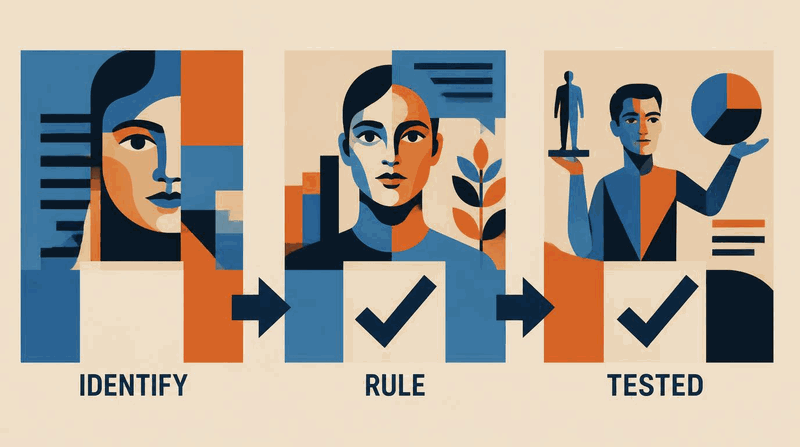
The precision gap is the difference between guidance and rules. Guidance says what to consider. A rule states what is not permitted and under what conditions an exception applies. Guidance is appropriate for human readers who can exercise judgement. Rules are required for anything that needs to apply a constraint without human interpretation at the point of application.
Reformulating standards from guidance to rules requires rewriting. The constraint needs to be expressible in a form that can be injected directly into a working session as binding input, not summarised, not paraphrased, but injected verbatim. That is a materially higher precision bar than standard architecture documentation practice sets. Clearing it is uncomfortable because it forces explicit decisions about edge cases that guidance can leave deliberately ambiguous. But ambiguity that is tolerable in a document is a failure mode in a model. A queryable model that returns ambiguous constraints does not help the decision being made.
The practical test is straightforward: take one constraint from your current architecture documentation and ask whether it is formulated precisely enough to be used at the moment of decision without the surrounding context. If the constraint only makes sense when read in relation to the paragraph before it and the section after it, it is not yet a rule. It is still guidance, and guidance does not survive the transition to a queryable model.
What a working model looks like in practice
A queryable architecture model has three structural properties that distinguish it from a well-organised document library.
First, each constraint is individually addressable. It has an identifier, a scope declaration, and a statement of what is not permitted. It does not depend on surrounding prose for its meaning.
Second, findability is testable. The model includes retrieval tests that verify a constraint can be located by the query it is expected to answer. If the test fails, the constraint is not findable, and a constraint that is not findable is not a constraint. It is a note.
Third, documents are rendered from the model rather than maintained alongside it. When a formal record is required, it is generated from the current state of the model and frozen at that point. The model continues to evolve. The document does not. This eliminates the drift that occurs when documents and models are maintained in parallel.
None of these properties require a specific tool or platform. They require a decision about how architecture artifacts are structured and a commitment to the precision level that querying demands. The tooling follows from the structural decision. The structural decision follows from understanding which artifact you are building and what job it needs to do.

Implementation guide: applying the Two-Speed Artifact in practice
Applying the Two-Speed Artifact framework does not require rebuilding your entire documentation practice at once. In my experience, the most effective starting point is a single diagnostic pass over the artifacts you currently maintain, followed by targeted restructuring of the highest-impact constraints.
Starting the diagnostic pass
Take fifteen minutes before your next architecture review or delivery session. Select one artifact you currently maintain and apply the diagnostic question: is this a model or a record? If it is supposed to function as a model, meaning it is expected to answer questions at the moment of decision, ask whether it is structured for querying or for reading. The answer will be immediately apparent.
If the artifact reads like a record but is being used as a model, identify the three constraints inside it that delivery teams are most likely to need under time pressure. Reformulate those three constraints as rules rather than guidance. Each rule should be self-contained: a statement of what is not permitted, the scope it applies to, and the conditions under which an exception applies. Test each rule by asking whether it makes sense without reading the surrounding context. If it does not, it is not yet a rule.
Common pitfalls
The most common pitfall is treating restructuring as a formatting exercise. Moving content from a narrative document into a structured file with headers does not make it queryable. The precision of the constraint statement has to change, not just its location. Guidance reformulated into a structured format is still guidance.
A second pitfall is maintaining documents and model artifacts in parallel. The moment a constraint exists in both a narrative document and a structured model entry, drift is inevitable. Establish a single source of truth for each constraint and generate documents from it. If the tooling to generate documents from the model does not exist yet, that is the next piece of work, not a reason to maintain both.
A third pitfall is declaring the model complete before testing retrieval. A constraint that exists in the model but cannot be located by the query it is expected to answer is not a functional constraint. Build retrieval tests alongside the constraints themselves.
Measuring progress
Progress in this work is measurable in concrete terms. The baseline question is: could a delivery team member locate a specific constraint without reading the surrounding document? Test this with actual team members, not by inspection. The gap between what you believe is findable and what is actually found is where the work lives.
A secondary measure is the ratio of constraints formulated as rules versus guidance. In a working model, the majority of constraints should be rule-formulated. A repository where most constraints still require interpretive reading is a library, not a model.
Conclusion
Architecture that cannot answer a question at the moment of decision gets bypassed. When it gets bypassed consistently, it stops shaping outcomes. The Two-Speed Artifact framework is not a documentation nicety. It is a structural response to a real failure mode: artifacts optimised for completeness, asked to do the job of something queryable, and unable to do it.
The distinction between model and document is the starting point. The precision required to make the model actually work at the moment of decision is the harder work that follows. Your mileage may vary depending on how your delivery process is structured, how much automated tooling is in the loop, and how much of your current documentation is reformulable without losing the judgement it was written to convey. But the diagnostic question applies regardless of context: is this artifact a model or a record, and is it precise enough to be used at the moment of decision?
Start with one constraint this week. Reformulate it as a rule. Test whether it can be found without surrounding context. That is the first step toward architecture that stays relevant rather than architecture that gets filed.
Watch the video for the personal story behind this analysis: Watch on YouTube
If you have encountered the static document trap in your own practice, or if you have found a different approach to keeping architecture artifacts useful under delivery pressure, I would like to hear about it in the comments.