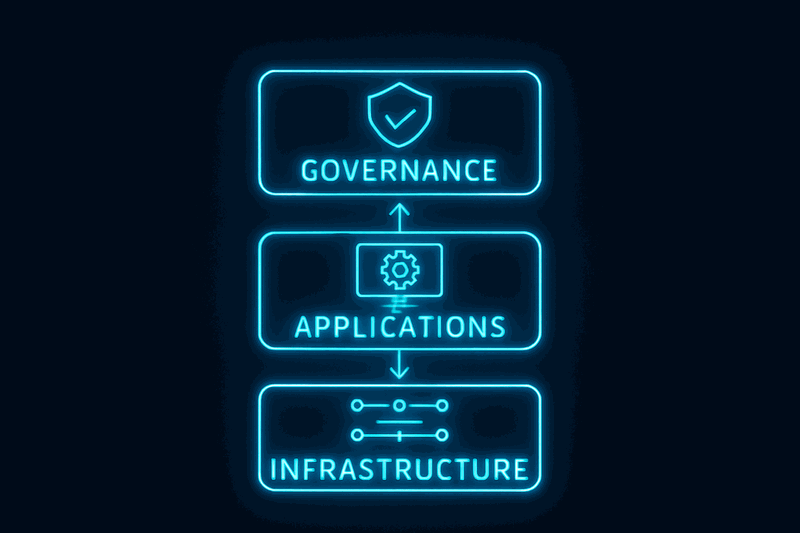
Most AI enterprise architecture content assumes you already understand what AI enterprise architecture is. That approach is backwards. When three different people ask "what is AI enterprise architecture?" and you get three different confusing answers, the problem is not individual knowledge gaps - it is the absence of a foundational framework that makes the concept comprehensible.
This post provides the direct answer: AI enterprise architecture consists of three distinct layers that stack on each other. Platform Architecture (infrastructure we build BEFORE AI), Application Architecture (AI systems we are building), and Governance Architecture (constraints ensuring quality). Understanding this three-layer distinction prevents the common mistake of building AI without infrastructure or governance support.
If you are an enterprise architect, solution architect, or technical lead who has been asked to explain AI enterprise architecture and struggled to provide a clear answer, this framework will give you the organizing principle that makes AI enterprise architecture understandable to developers, architects, and managers alike.
The Three Confused Questions

Six months into leading AI architecture at a government agency, I encountered the same problem repeatedly. Three people approached me in one week with what seemed like the same question phrased three different ways: "What is AI enterprise architecture?"
The developer asked about platform infrastructure - data lakehouses, orchestration frameworks, model serving APIs. The enterprise architecture leader asked about application patterns - when to use generative AI versus agentic systems versus traditional machine learning. The governance manager asked about compliance controls - standards enforcement, decision documentation, validation pipelines.
I could answer each question individually, but I had no unifying framework to explain how platform, application, and governance fit together as layers of AI enterprise architecture. When I searched for guidance, industry sources made the same assumption. Forrester discussed "real-time enterprise architecture" without defining AI enterprise architecture fundamentals. Databricks jumped straight to infrastructure implementation details. Tyk focused on API governance patterns. All assumed foundational knowledge that did not exist.
The confusion was not individual - it was structural. People were asking about different layers of the same architecture stack without realizing it. This recognition led to mapping every AI architecture concern raised over six months onto a whiteboard. Three clear clusters emerged: infrastructure questions, application questions, and governance questions. These became the three architecture layers that stack on each other.
The Three-Layer Framework
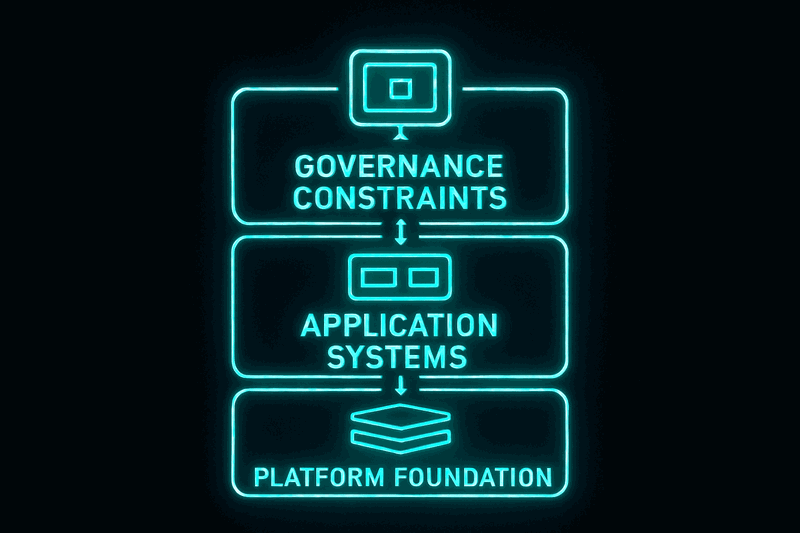
AI enterprise architecture consists of three distinct layers that enable and constrain each other:
Platform Architecture answers "what do we build BEFORE building AI?" This is the foundational infrastructure layer: data lakehouses and vector stores, orchestration frameworks for workflows, model serving APIs with caching and optimization, monitoring systems for observability and cost tracking. Platform Architecture provides the shared infrastructure that enables AI applications to exist without rebuilding data pipelines and serving infrastructure for every project.
Application Architecture answers "what AI systems are we building?" This layer implements AI capabilities on top of platform infrastructure. Three primary types exist: Generative AI (reactive generation like RAG systems, chatbots, copilots), Agentic AI (autonomous goal-directed systems with planning and tool use), and Traditional ML (prediction and classification like fraud detection and recommendations). Each type requires different architectural patterns and design approaches.
Governance Architecture answers "how do we ensure quality and compliance?" This is not bolt-on compliance controls added after deployment. Governance Architecture consists of design-time constraints that ensure AI systems meet enterprise standards before deployment: architecture repository with capabilities and standards, normative language standards using RFC 2119 MUST/SHOULD/MAY hierarchy, architecture decision records providing decision context, and validation pipelines that check compliance before deployment.
Think of this like building codes for construction. Platform Architecture is the building infrastructure - foundation, utilities, elevators, HVAC systems. Application Architecture is the tenants and their businesses - retail shops, offices, apartments. Governance Architecture is building codes and regulations - fire codes, accessibility standards, occupancy limits. Just as you cannot put tenants in a building without infrastructure, you cannot deploy AI applications without platform support. Just as tenants must follow building codes, AI applications must conform to governance standards.
Nobody questions that buildings need infrastructure AND tenants AND regulations - all three are obviously necessary. But in AI, organizations often skip platform infrastructure (forcing every AI project to rebuild data pipelines) or skip governance (bolt-on compliance after applications are deployed). The building analogy makes the necessity of all three layers obvious.

Platform Architecture: What You Build Before AI
The Platform Architecture layer provides the foundational infrastructure that enables AI applications to exist. This is what you build BEFORE building AI systems. Without platform infrastructure, every AI project must rebuild data access, model serving, and monitoring from scratch.
Data Layer Components: Data lakehouses provide unified storage for structured and unstructured data with SQL query capabilities. Vector stores enable similarity search for retrieval-augmented generation patterns. Feature stores provide consistent feature engineering and serving for traditional machine learning models. Data lineage tracking ensures governance and debugging capabilities across the data pipeline.
Orchestration Layer Components: Workflow orchestration frameworks manage complex multi-step AI processes. These systems coordinate data preparation, model training, inference, and result processing. Scheduling and dependency management ensure reliable execution of AI workflows. Integration with external systems enables AI processes to interact with enterprise applications and data sources.
Model Serving Layer Components: Model serving APIs provide consistent interfaces for AI model inference. Caching systems optimize response times and reduce computational costs. Load balancing distributes inference requests across multiple model instances. Version management enables A/B testing and gradual rollout of model updates. Auto-scaling adjusts computational resources based on demand patterns.
Monitoring Layer Components: Observability systems track model performance, accuracy drift, and system health. Cost tracking monitors computational expenses and resource utilization. Performance monitoring identifies bottlenecks and optimization opportunities. Alert systems notify teams of anomalies or failures requiring intervention.
This is the Platform-First Principle: establish shared infrastructure once, enabling all AI applications to leverage it instead of rebuilding foundational capabilities for every project. Organizations that skip platform infrastructure force every AI initiative to solve the same infrastructure challenges repeatedly, leading to duplicated effort and inconsistent implementations.
The direct answer to "what is enterprise AI platform architecture?" is these four layers working together: data infrastructure that provides unified access to enterprise information, orchestration infrastructure that coordinates complex AI workflows, serving infrastructure that provides reliable model inference, and monitoring infrastructure that ensures system health and performance.
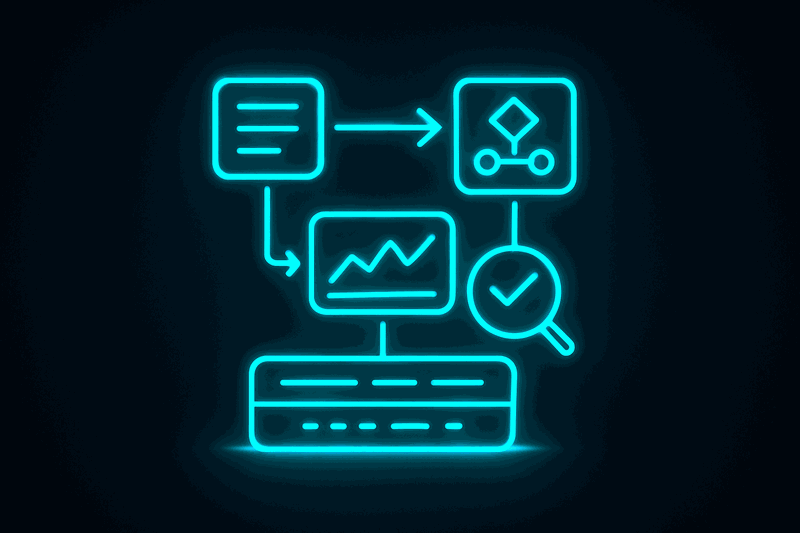
Platform Architecture enables Application Architecture by providing the infrastructure foundation. Without platform maturity, AI applications cannot scale beyond proof-of-concept implementations. The platform layer must be established before application proliferation begins, or organizations face the infrastructure debt of rebuilding foundational capabilities for every AI project.
Application Architecture: The Three Types of AI Systems
Application Architecture implements AI capabilities on top of platform infrastructure. Three primary types exist, each with fundamentally different characteristics requiring different architectural approaches. Understanding Application Architecture Tiers prevents the common mistake of forcing one architecture pattern onto a different application type.
Generative AI Applications are reactive generation systems. You provide a prompt, they generate content. RAG systems retrieve relevant context and generate responses. Chatbots engage in conversational interfaces. Copilots assist with code generation and documentation. Content generation tools create marketing copy, technical documentation, or creative assets. The architectural pattern centers on prompt engineering, context retrieval, output validation, and human-in-the-loop feedback mechanisms.
Agentic AI Applications are autonomous goal-directed systems. They plan multi-step actions, use tools, maintain memory across interactions, and adapt strategies based on outcomes. Planning agents decompose complex goals into executable steps. Tool-using agents interact with external systems and APIs. Memory-enabled agents maintain context across extended interactions. The architectural pattern centers on goal decomposition, tool orchestration, memory management, and autonomous decision-making capabilities.
Traditional ML Applications are prediction and classification systems. Input data produces specific output predictions. Fraud detection systems analyze transaction patterns. Recommendation engines suggest relevant products or content. Demand forecasting predicts future resource requirements. Risk assessment models evaluate loan applications or insurance claims. The architectural pattern centers on feature engineering, model training pipelines, inference optimization, and continuous learning from feedback data.
The decision matrix for application type selection: Content generation requirements indicate Generative AI architecture. Complex multi-step autonomous tasks indicate Agentic AI architecture. Prediction, classification, or pattern recognition requirements indicate Traditional ML architecture. Do not try to force one architecture pattern onto a different application type - the characteristics are fundamentally different.
Generative AI is reactive (you prompt, it generates), Agentic AI is proactive (it plans, acts, adapts), Traditional ML is predictive (input produces output). Each type needs different infrastructure support, different governance approaches, and different operational patterns. The Application Architecture Tiers framework helps organizations match architectural patterns to use case requirements instead of defaulting to the most familiar approach.

Governance Architecture: Constraints That Scale
Governance Architecture is not bolt-on compliance controls added after AI applications are deployed. It consists of design-time constraints that ensure AI systems meet enterprise standards before deployment. This is Governance-as-Constraints: preventing non-conforming AI from being created in the first place rather than detecting violations after they occur.
Architecture Repository as Constraints: The repository structure from TOGAF becomes the governance layer for AI development. Capabilities define what AI systems can do. Standards specify MUST/SHOULD/MAY requirements using RFC 2119 normative language. Guides provide implementation patterns and best practices. Plans document strategic AI initiatives and roadmaps. Proposals capture architecture decisions before implementation begins.
Standards Enforcement Patterns: Machine-readable standards enable automated validation of AI-generated recommendations. MUST requirements are absolute constraints that AI cannot violate. SHOULD requirements are strong recommendations that AI follows unless specific justification exists. MAY requirements are optional behaviors that AI can choose based on context. This normative language hierarchy transforms documentation into executable governance that AI systems can follow consistently.
Decision Context Through ADRs: Architecture Decision Records provide AI with the reasoning behind past architectural choices. When AI proposes changes that contradict previous decisions, ADRs provide context about why those decisions were made and what constraints influenced them. This prevents re-litigation of settled architectural choices and ensures AI recommendations align with established enterprise direction.
Validation Pipeline Integration: Design-time validation checks AI-generated recommendations against enterprise standards before deployment. Automated compliance checking ensures conformance without manual review overhead. Policy-as-code enables governance rules to be versioned, tested, and deployed like application code. Continuous validation maintains compliance as AI systems evolve and enterprise standards change.
At a major financial institution, the platform team built excellent AI infrastructure and application teams successfully deployed RAG systems and chatbots. Six months later, compliance discovered dozens of AI applications with inconsistent governance - no standards, no documented decisions, no validation controls. Governance was being bolted on after applications were already in production.
Compliance wanted to shut down all AI projects until governance could be established. Business units were furious about potential delays. Platform teams argued governance was not their responsibility, application teams argued governance was not in requirements. The governance layer was missing from the three-layer architecture.
Introducing governance-as-constraints resolved the conflict. Standards using MUST/SHOULD/MAY normative language, decision context through ADRs, validation pipeline checking compliance before deployment. Positioning governance as the third architecture layer, not a separate concern. Compliance accepted gradual governance rollout instead of shutdown. Most applications came into conformance within three months through automated validation. Most importantly, new AI projects now include governance from design phase, not as bolt-on addition.

The Three Anti-Patterns That Kill AI Initiatives
When organizations misunderstand the three-layer architecture, predictable anti-patterns emerge that undermine AI initiatives. Recognizing these patterns enables corrective action before they cause project failures.
Anti-Pattern 1: Platform-First Without Governance leads to ungoverned AI proliferation. Organizations build excellent platform infrastructure - data lakehouses, orchestration frameworks, model serving APIs, monitoring dashboards. Application teams leverage the platform to deploy AI systems rapidly. Six months later, dozens of AI applications exist with inconsistent standards, no decision documentation, no validation controls. Compliance discovers the ungoverned proliferation and demands shutdown until governance can be established. Platform infrastructure without governance constraints enables rapid proliferation of non-compliant AI systems.
Anti-Pattern 2: Application-Only Focus forces every AI project to rebuild infrastructure. Organizations jump directly to building AI applications without establishing platform foundation. Every RAG system rebuilds document processing pipelines. Every chatbot implements its own model serving infrastructure. Every recommendation engine creates custom monitoring dashboards. Development velocity slows as teams repeatedly solve the same infrastructure challenges. Technical debt accumulates as inconsistent implementations become difficult to maintain and scale.
Anti-Pattern 3: Governance-Only Approach creates standards without platform support. Organizations establish comprehensive AI governance frameworks - detailed standards documents, approval processes, compliance checklists. But no platform infrastructure exists to support governance enforcement. Manual review processes become bottlenecks. Standards cannot be automatically validated. Governance becomes bureaucratic overhead instead of enabling constraint. Teams circumvent governance to maintain development velocity, defeating the purpose of establishing standards.
Which anti-pattern is YOUR organization doing right now? Most organizations exhibit one of these patterns because they focus on a single architecture layer without understanding how the three layers enable and constrain each other. Platform without governance enables ungoverned proliferation. Applications without platform force infrastructure rebuilding. Governance without platform becomes bureaucratic overhead.
The three-layer framework prevents these anti-patterns by positioning platform, application, and governance as interdependent layers that must be developed together. Platform provides infrastructure that applications leverage and governance constrains. Applications implement capabilities that platform enables and governance validates. Governance constrains both platform and application to ensure enterprise compliance and quality standards.

Architecture Assessment and Next Steps
The three-layer framework is not just conceptual - it is a diagnostic tool. Gap assessment reveals which layer needs attention first, enabling strategic capability building instead of ad-hoc AI project proliferation.
Platform Architecture Assessment: Do you have data lakehouses providing unified access to enterprise information? Do orchestration frameworks coordinate complex AI workflows? Do model serving APIs provide consistent inference interfaces? Do monitoring systems track AI performance, costs, and system health? If platform infrastructure is weak, prioritize infrastructure foundation before application proliferation begins.
Application Architecture Assessment: Do you have established patterns for generative AI applications like RAG systems and chatbots? Do you have architectural approaches for agentic AI systems with planning and tool use capabilities? Do you have traditional ML patterns for prediction and classification use cases? If application architecture is weak, focus on establishing patterns for the AI application types most relevant to your enterprise requirements.
Governance Architecture Assessment: Do you have an architecture repository with AI capabilities, standards, and guides? Do you have machine-readable standards using RFC 2119 normative language? Do you have ADRs documenting AI architecture decisions? Do you have validation pipelines checking compliance before deployment? If governance architecture is weak, establish design-time constraints before AI proliferation creates compliance debt.
A technology consulting firm wanted to offer AI architecture services but struggled to position their capability. They had strong application architecture expertise designing generative and agentic systems but kept losing deals to competitors emphasizing platform infrastructure. The three-layer gap assessment revealed the issue: strong application layer, weak platform layer. Enterprises wanted comprehensive AI architecture guidance covering all three layers.
The firm hired platform infrastructure experts, created platform architecture service offerings, positioned as full-stack AI architecture covering all three layers. Win rate increased from 30% to 65% within six months. More importantly, clients received complete architecture guidance instead of application-only patterns. The gap assessment enabled strategic capability building that addressed competitive disadvantage.
Most organizations are strong in one or two layers but weak in the third. Platform-strong organizations often lack governance constraints. Application-strong organizations often lack platform foundation. Governance-strong organizations often lack platform support for enforcement. Identifying the gap enables focused investment where it will have the greatest impact on AI initiative success.
Run three-layer gap assessment for your organization this week. Score platform architecture maturity, application architecture maturity, and governance architecture maturity. Identify which layer is weakest - that is where you focus next. The assessment provides strategic direction for systematic AI capability development instead of reactive responses to immediate project demands.
Conclusion
AI enterprise architecture consists of three distinct layers that stack and interact: Platform Architecture providing infrastructure foundation, Application Architecture implementing AI capabilities, and Governance Architecture ensuring quality and compliance through design-time constraints. Understanding this three-layer distinction prevents the common mistake of building AI without infrastructure or governance support.
The Platform-First Principle establishes shared infrastructure once, enabling all AI applications to leverage it instead of rebuilding foundational capabilities. Application Architecture Tiers match architectural patterns to use case requirements - generative, agentic, or traditional ML approaches. Governance-as-Constraints prevents non-conforming AI from being created through standards, ADRs, and validation pipelines applied before deployment.
Organizations that misunderstand the three layers fall into predictable anti-patterns: platform without governance enables ungoverned proliferation, applications without platform force infrastructure rebuilding, governance without platform becomes bureaucratic overhead. The three-layer framework prevents these failures by positioning the layers as interdependent components that must be developed together.
The framework is also a diagnostic tool. Gap assessment reveals which layer needs attention first, enabling strategic capability building. Most organizations are strong in one or two layers but weak in the third. Identifying the gap focuses investment where it will have the greatest impact on AI initiative success.
Watch the video for the complete story behind this framework and the personal experiences that led to its development: https://www.youtube.com/watch?v=w26y80LfXUw
Which AI architecture layer is YOUR organization weakest in? Platform, Application, or Governance? Share your gap assessment results in the comments.
Resources
This three-layer framework serves as the foundation for understanding AI enterprise architecture. For deep dives into specific governance patterns, platform implementation details, and application architecture approaches, explore the related content that builds on this foundational understanding.