Introduction
A 466-line file that looked complete, was structurally coherent, and had never once consulted the governing standard it was supposed to implement. That is not a hypothetical. That is what silent non-compliance looks like when AI agent workflows operate without governance structure.
This article expands on my video about the documentation-first inversion, a governance pattern I developed after encountering two distinct failure modes in AI-assisted architecture work. The video covers the personal experience behind the pattern. This article develops the architectural reasoning in more depth and gives you a repeatable implementation model.
The target audience is architects and senior engineers who are already using AI agents for documentation, configuration, or artifact generation tasks. If you are at the stage of evaluating whether to use AI agents at all, this article assumes you have moved past that question. The concern here is governance: how do you ensure that what the agent produces is actually compliant with the standards that govern it, not merely visually indistinguishable from something that would be?
Two failure modes drive the answer: silent non-compliance from pattern-matching, and process instruction decay under task context shifts. The documentation-first inversion addresses both.
Why AI agents produce confident, non-compliant output
The failure mode that triggered this governance pattern was not a dramatic error. There was no hallucinated content, no obviously broken structure, no output that any reviewer would immediately flag. The agent produced a configuration artifact for a design system. The artifact had the correct file format, a logical internal structure, and content that was contextually appropriate to the system it described. It was also missing an entire required section, because the governing standard that defined that requirement had never been consulted.
Understanding why this happens requires being precise about how large language models approach generation tasks. When an agent is asked to create an artifact, its most available signal is existing artifacts of the same type. The natural workflow is: locate a reference file, identify its structural pattern, reproduce that pattern with content appropriate to the current context. This is not a flaw. It is genuinely useful behaviour that produces coherent outputs quickly. The problem is that this workflow is structurally incapable of detecting absence. If the reference file did not contain a presentation configuration section, the agent has no signal that one is required. The governing standard is a document the agent would have to deliberately seek out, read, and cross-reference against its output. Without a workflow that enforces that lookup, the lookup does not happen.
The confidence problem at scale
What makes this dangerous in enterprise contexts is the confidence of the output. A 466-line file does not look like a guess. It has the visual weight of something carefully built. In a team operating at speed, with multiple agents running multiple tasks in parallel, no individual reviewer has the bandwidth to cross-reference every output against every governing standard. The assumption that length and structural coherence imply specification compliance is understandable. It is also wrong, and it is the assumption that silent non-compliance exploits.
In my experience, the moment an agent has an existing file to reference, the governing standard becomes invisible to it unless the workflow explicitly forces the lookup. I have tested this across different repository structures and different prompt formulations. The pattern holds: pattern-matching displaces specification-reading unless something structural prevents it.
The second failure mode: instruction decay
The obvious response to this problem is to instruct the agent to read the governing standard first. I tried this. At the start of a session, I gave an explicit instruction: documentation is the primary source, reference it before writing anything. The agent acknowledged the instruction. I felt, briefly, that the problem was solved.
It was not. When the next implementation task arrived, the agent searched for existing files to copy. The session-start instruction had not been forgotten in any dramatic sense. It had been displaced by task context. The specific artifact being built, the files visible in the repository, the immediate question in front of the agent: all of that dominated over an instruction given earlier in the conversation. Process instructions decay. Task context persists.
These two failure modes are structurally distinct. Pattern-matching is about what the agent reaches for by default. Instruction decay is about what the agent retains as the conversation advances. Solving one does not solve the other. Both require a governance response, and a session-start instruction addresses neither durably.

The documentation-first inversion: structure, mechanism, and application
The documentation-first inversion is a governance pattern that redirects agent behaviour rather than fighting it. The insight behind it is that agents respond to structure, not to remembered preferences. If the structure of the workflow enforces a specification lookup before implementation begins, the lookup happens. If it does not, the lookup is optional, and optional steps are the first casualty of task context pressure.
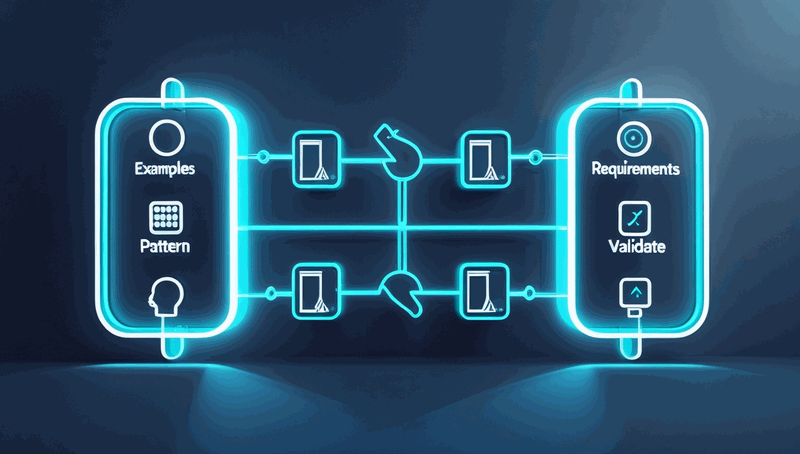
The inversion replaces the natural LLM workflow sequence with a forced alternative. Where the natural sequence runs: find example, match pattern, generate output, the inversion runs: find specification, extract requirements, use template, validate against checklist. The output at the end may look similar. The path to it is fundamentally different, and the path is what governance controls.
The research phase: forcing the specification lookup
The first component of the inversion is the research phase. Before any implementation task begins, one question is required: what standard governs this artifact? The agent cannot proceed to implementation until it has answered that question with a document reference, not a general statement. "I will follow best practices" is not an acceptable answer. The name and location of the governing document is the required answer.
This single question does more governance work than any amount of session-start instruction. It makes the specification lookup a prerequisite for progress rather than a preference stated earlier and gradually forgotten. The agent cannot pattern-match its way past it, because the question is asked at the decision point, not at session start.
Once the governing standard is identified, a second question follows: is there a template that encodes the required sections? This question is where the inversion becomes durable across sessions rather than just within them.
The template: encoding specification into the path of least resistance
If a template exists, the agent uses it. If no template exists, creating one becomes part of the current deliverable, not a separate task deferred to later. This is the mechanism that makes the inversion self-reinforcing over time.
Consider what happens the next time an agent is asked to create an artifact of the same type. Its natural behaviour is to search for an existing file to reference. If the previous session created a template that encodes all required sections, the agent finds that template. The path of least resistance now leads to the specification-compliant structure rather than away from it. The inversion has changed the default behaviour of future agents without requiring future agents to receive any special instruction.
In the session that produced the 466-line non-compliant file, three documentation improvements were committed once the inversion was applied: the governing standard was updated to clarify the missing requirement, a template was created with all required sections explicitly present, and the entry-point documentation was enhanced with a mandatory reading list. The template matters most of the three. The governing standard update clarifies what is required. The template makes compliance the easiest path to follow.
The validation checklist: replacing claims with structured comparison
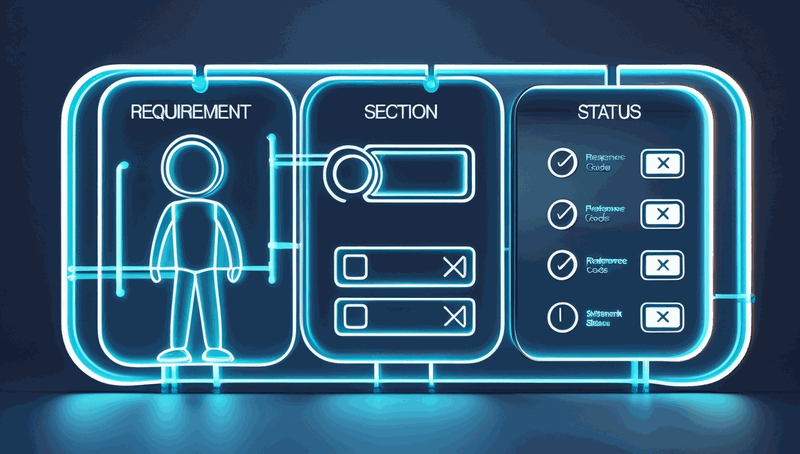
The third component is the validation checklist, applied after implementation and before the output is accepted. The agent does not mark the task complete with a general statement of completion. It presents a checklist in which each item maps to a specific requirement in the governing standard, and each item is marked as present or absent in the output.
The distinction between a checklist and a completion claim is not cosmetic. A completion claim is self-referential: the agent is assessing its own output against its own sense of what a complete output looks like, which is derived from the same pattern-matching process that produced the output. A validation checklist is externally anchored: each item traces back to a named requirement in the governing standard. One can be wrong without the agent knowing it is wrong. The other surfaces absence explicitly.
In practice, this shifts the governance burden from human inspection of outputs to human verification of process. Inspecting a 466-line file for a missing section requires the reviewer to know in advance what should be there. Reviewing a checklist that maps to the governing standard requires the reviewer to verify that the agent performed the lookup and traced each requirement to the output. The cognitive load is lower, the failure surface is smaller, and the review is more reliable.
The checkpoint protocol: maintaining discipline across task context shifts
The three components above address the pattern-matching failure mode. The checkpoint protocol addresses instruction decay. Rather than stating workflow priorities once at session start and trusting them to persist, the workflow is structured around explicit checkpoints at decision points.
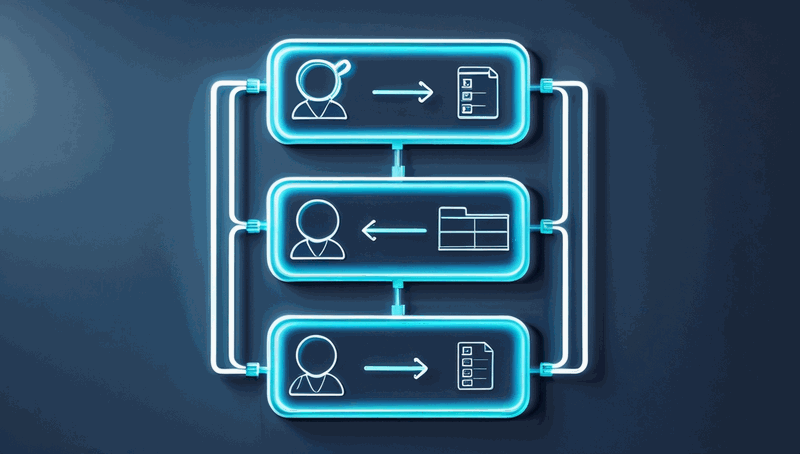
The pre-implementation checkpoint asks: what standard governs this artifact, and does a compliant template exist? The post-implementation checkpoint asks: present the validation checklist against the governing standard. These two checkpoints bracket every implementation task. Because they are asked at the decision points rather than stated in advance, they do not decay. Task context cannot displace them because they are embedded in the task structure itself.
When I applied this checkpoint protocol to subsequent tasks in the same session where the 466-line file was produced, false completion claims dropped to zero. The agent had not changed. The structure had changed. The human role had changed from task giver to process guardian, and the checkpoints at decision points maintained the discipline that session-start instructions could not.
What the inversion does not solve
The inversion assumes a governing standard exists and is findable. If documentation is fragmented, outdated, or inconsistent, the agent will find the wrong specification, read it faithfully, and produce output that is compliant with the wrong standard. This is not a failure of the inversion. It is a diagnostic signal. In my experience, applying the inversion consistently exposed documentation gaps I had not known existed. When the agent cannot find the governing standard, that absence is information about the documentation ecosystem, and it surfaces earlier than it would if agents were simply pattern-matching past the gap.
The inversion also does not address the quality of the governing standard itself. A governing standard that is ambiguous, incomplete, or internally inconsistent will produce ambiguous, incomplete, or inconsistent compliant outputs. The inversion enforces the lookup. It cannot improve what is found.
Applying the inversion to a YAML configuration example
To make the checkpoint protocol concrete, here is the pre-implementation checkpoint as a structured prompt pattern:
pre_implementation_checkpoint:
  required_questions:
    - "What standard governs this artifact? Provide the document name and location."
    - "Does a template exist that encodes all required sections? If not, template creation is part of this task."
  acceptance_criteria:
    - governing_document: "Named document reference required, not a general statement"
    - template_status: "Existing template confirmed, or new template committed as deliverable"
  gate: "Implementation does not begin until both criteria are met"

post_implementation_checkpoint:
  required_output:
    - "Validation checklist with one item per requirement in the governing standard"
    - "Each item marked present or absent in the output"
  acceptance_criteria:
    - checklist_format: "Requirement-by-requirement, not a summary claim"
    - traceability: "Each checklist item cites the governing standard section it maps to"
  gate: "Output is not accepted until checklist is reviewed by human"
This structure is not a prompt template to copy verbatim. It is a representation of the checkpoint logic that should be embedded in whatever workflow tooling or interaction model you use with your agents. The specific phrasing will vary. The gate logic should not.
Implementing the inversion in practice
The inversion is not a tool configuration. It is a workflow discipline that requires the human operator to change their role from task giver to process guardian. That shift is the hardest part of implementation, because the instinct to accept visually coherent output as evidence of correctness runs deep.
Starting point: the fifteen-minute checkpoint
Before your next AI-assisted implementation task, spend fifteen minutes running the pre-implementation checkpoint. Ask the agent what standard governs the artifact. Do not accept a general statement. Require a document name and location. Then ask whether a compliant template exists. If it does not, make template creation part of the current task before implementation begins. At the end of the task, require a validation checklist against the governing standard before accepting the output.
After fifteen minutes, you will know two things: whether your current workflow has a silent non-compliance problem, and whether your documentation ecosystem has a gap the agent cannot navigate. Both are valuable findings.
Common failure points to anticipate
The most common failure point is accepting a governing document reference that is too vague. "I will follow the architecture standards" is not a reference. A specific document name and location is a reference. Hold the gate until the agent provides the latter.
The second common failure point is accepting a completion claim instead of a checklist. Agents will often respond to the post-implementation checkpoint with a summary statement: "The output covers all required sections." That is a claim, not a checklist. Require the requirement-by-requirement format. If the agent cannot produce it, that inability is diagnostic: either the governing standard was not actually read, or it does not contain the specificity needed to support a checklist.
The third failure point is treating template creation as optional. When no template exists, it is tempting to proceed with implementation and defer the template to a separate task. Do not defer it. The template is the mechanism that makes the inversion durable. Without it, the next agent will repeat the same pattern-matching behaviour that produced the non-compliant output in the first place.
Measuring success
Success in the first session looks like: a named governing document identified before implementation, a template committed as part of the deliverable, and a validation checklist that surfaces at least one gap or confirmation per required section. If the checklist surfaces no gaps and the output passes every item, that is a successful outcome. If the checklist surfaces a gap, that is also a successful outcome: the inversion caught what pattern-matching would have missed.
The metric that matters over time is not checklist pass rate. It is the elimination of false completion claims: outputs accepted as complete that were later found to be non-compliant. In my experience, that number drops to zero once the checkpoint protocol is consistently applied.
What changes when the inversion is in place
Before the documentation-first inversion, I measured success by whether the output looked complete. After it, I measured success by whether the agent had read the governing standard before writing the first line. That shift in measurement is the practical change the inversion produces. It does not matter how long the file is if the specification was never consulted.
The broader implication for AI governance at enterprise scale is this: the answer to silent non-compliance is not better prompts. It is better architecture. Prompts are instructions. Instructions decay. Structure enforces. When the specification lookup is a structural prerequisite for implementation, it happens consistently. When it is a stated preference, it happens until task context displaces it.
Your mileage may vary on the specific checkpoint questions that work best in your context. The governing standard question and the validation checklist are the two I have found consistently effective, but your repository structure, your team's workflow, and the maturity of your documentation will shape how you implement the inversion. The pattern is transferable. The exact implementation is yours to adapt.
Three things to carry forward. First, visual coherence is not specification compliance. An output that looks complete has passed a pattern-matching check, not a governance check. Second, process instructions decay under task context pressure. Checkpoints at decision points maintain discipline that session-start instructions cannot. Third, templates that encode requirements prevent future agents from repeating the same omission. They are not documentation housekeeping. They are governance infrastructure.
If you have encountered silent non-compliance in your own AI-assisted work, or if you have found a different governance mechanism that addresses the same failure modes, I would like to hear about it in the comments. The patterns I have described here emerged from a specific repository structure and workflow context. Other contexts will surface variations worth understanding.